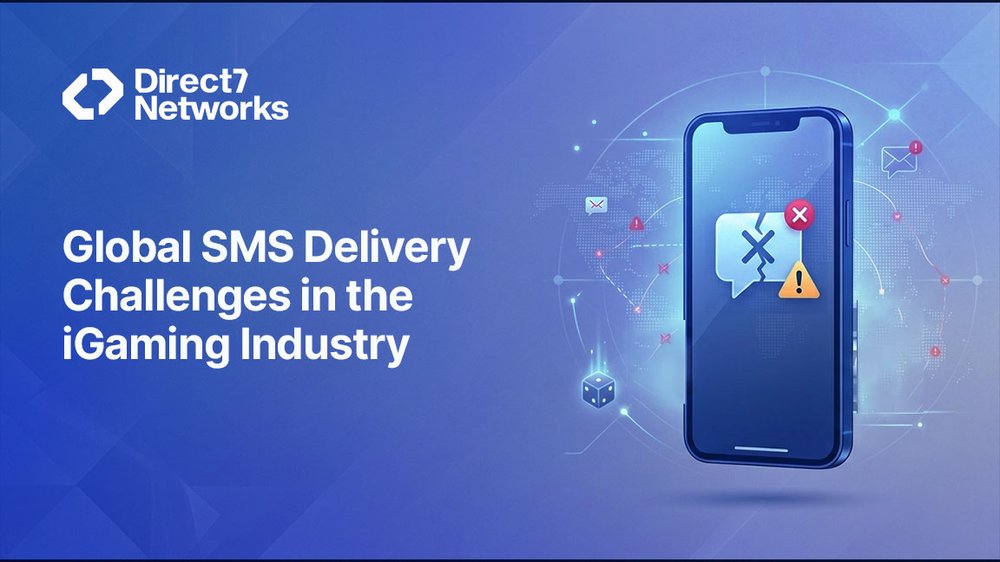

Global SMS Delivery Challenges in the iGaming Industry
A player tries to log in minutes before a big match.
They request an OTP.Nothing arrives.
They tap “resend.” Still nothing.
By the time the message shows up, the odds have changed or the player has already closed the app.
This is how global SMS delivery problems show up in iGaming: not as technical incidents, but as lost bets, failed logins, abandoned deposits, and angry support tickets. For teams building and running iGaming platforms, SMS is not “just messaging.” It’s part of the core product experience.
Let’s break down why global SMS delivery is so hard in iGaming, where things usually go wrong, and what teams can do to reduce risk without overengineering.
Why SMS matters more in iGaming than most industries
iGaming relies on SMS at moments when users care deeply about speed and certainty:
- Login and OTP verification
- Deposit and withdrawal alerts
- Account security notifications
- Responsible gaming messages
- Regulatory and transactional updates
If a marketing SMS arrives late, it’s annoying.
If an OTP arrives late, the user is locked out.
That difference explains why iGaming platforms feel SMS delivery issues more sharply than many other digital businesses.
The invisible complexity behind “send SMS”
From the outside, sending an SMS looks simple. Behind the scenes, it’s a relay race across multiple systems and each handoff can fail.
Here’s a simplified path:
Platform → SMS API → Aggregator → Local carrier → User’s device
In global iGaming operations, this path changes by country, operator, and sometimes even by route within the same country. Each variation brings its own rules, filters, and risks.
Challenge 1: Country-specific regulations and filtering
Many iGaming brands operate across dozens of markets. Each one treats gaming-related SMS differently.
Some common realities:
- Certain countries restrict gambling-related sender IDs
- OTP messages may require pre-registration or whitelisting
- Transactional vs promotional classification matters
- Time-of-day restrictions apply in some regions
A message that delivers perfectly in one country may be blocked silently in another.
Example:
An OTP template approved in one European market gets filtered in parts of Asia because the sender ID isn’t registered locally.
From the user’s perspective, it looks like your platform failed, not the network.
Challenge 2: Inconsistent delivery speed across regions
Speed matters most during:
- Login
- Withdrawals
- Password resets
Yet SMS delivery speed varies wildly by geography.
In some regions, messages arrive in seconds. In others, delays of 30–90 seconds are common, especially during peak traffic or sporting events.
This creates a dangerous mismatch:
- Your app expects instant verification
- The network delivers “eventually”
When teams design flows assuming instant delivery everywhere, conversion drops quietly.
Challenge 3: Grey routes and unstable delivery paths
To reduce costs, some routes use unofficial or semi-authorized paths (often called grey routes). They may work for a while, until they don’t.
Symptoms include:
- Sudden spikes in delivery failures
- Messages delivered hours later
- OTPs arriving after expiration
- Inconsistent delivery reports
In iGaming, this is especially risky. One unstable route during a high-traffic event can trigger a wave of failed logins and withdrawals.
Cheap routes often become expensive through lost revenue and support overhead.
Challenge 4: Sender ID and branding issues
Sender IDs help users recognize who a message is from. They also trigger carrier-level rules.
Common problems:
- Sender ID not approved in a specific country
- Alphanumeric IDs replaced by random numbers
- Messages blocked due to brand mismatch
- One sender working for alerts but failing for OTPs
For iGaming brands, sender trust matters. If users don’t recognize the sender, they hesitate especially when security is involved.
Challenge 5: Traffic spikes during live events
iGaming traffic isn’t steady. It spikes hard.
Big tournaments, match days, jackpot draws, all create sudden bursts of OTP and alert traffic. SMS systems that work fine at average volume may struggle at peak.
When delivery queues build up:
- OTPs arrive late
- Retry logic floods the network
- Costs increase without improving success rates
This is where capacity planning becomes a product concern, not just an infrastructure one.
A practical framework: Designing SMS flows for global reality
Instead of asking “How do we send SMS?”, strong iGaming teams ask “How do we design for failure?”
Here’s a simple DELIVER framework that helps.
Detect
Track delivery reports, latency, and failure patterns by country, not just overall success rate.
Expect delays
Design OTP expiry times and retry logic based on real regional performance, not ideal conditions.
Localize
Register sender IDs, templates, and routes per market. Avoid one-size-fits-all setups.
Intelligent fallback
When SMS is delayed or fails, switch channels (WhatsApp, voice) where allowed.
Verify selectively
Use SMS where it matters most. Don’t overuse it for low-risk actions.
Evaluate routes regularly
Routes that worked last quarter may degrade quietly. Re-evaluation should be ongoing.
Real-world example: OTP failures during withdrawals
A common scenario:
- OTP required for withdrawal
- SMS delayed due to carrier congestion
- User retries multiple times
- Support ticket created
- Withdrawal abandoned
What fixes this isn’t just “better SMS.”
Teams that reduce this problem usually:
- Extend OTP validity slightly for high-latency regions
- Add a secondary delivery channel
- Trigger OTP only after confirming route availability
- Show clear UI feedback instead of silent waiting
Small changes, big impact.
How SMS challenges affect non-technical teams
SMS delivery issues ripple beyond engineering.
Marketing
Failed OTPs block user reactivation and bonus redemption, lowering campaign ROI.
Operations
More manual verification, more tickets, more escalations.
Compliance
Missing or delayed transactional messages can create audit gaps.
Product
Poor SMS experience feels like poor UX, even if the UI is perfect.
That’s why SMS reliability deserves the same attention as payments or odds engines.
Choosing partners who understand iGaming realities
Global SMS delivery isn’t just about coverage maps. It’s about behavior under pressure.
Teams often look for:
- Direct carrier routes in regulated markets
- Transparent delivery reporting
- Multi-channel fallback options
- Experience with gaming traffic patterns
Providers like D7 Networks are often used in iGaming contexts where regional reliability, route control, and compliance visibility matter more than lowest-cost messaging.
The goal isn’t perfection, it’s predictability.
Where SMS still makes sense and where it doesn’t
SMS remains critical for:
- OTP and security flows
- Regulatory and transactional alerts
- Broad device compatibility
But relying on SMS alone for everything is risky. Many iGaming platforms now treat SMS as one layer in a wider communication strategy.
When SMS is designed thoughtfully, users rarely notice it. When it’s brittle, everyone does.
Final takeaway
Global SMS delivery challenges in the iGaming industry aren’t edge cases. They’re daily realities shaped by regulation, infrastructure, and user behavior.
Teams that accept this and design around it see fewer failures, lower support load, and smoother user journeys.
The real win isn’t sending more messages.
It’s making sure the right message arrives, when it matters most.