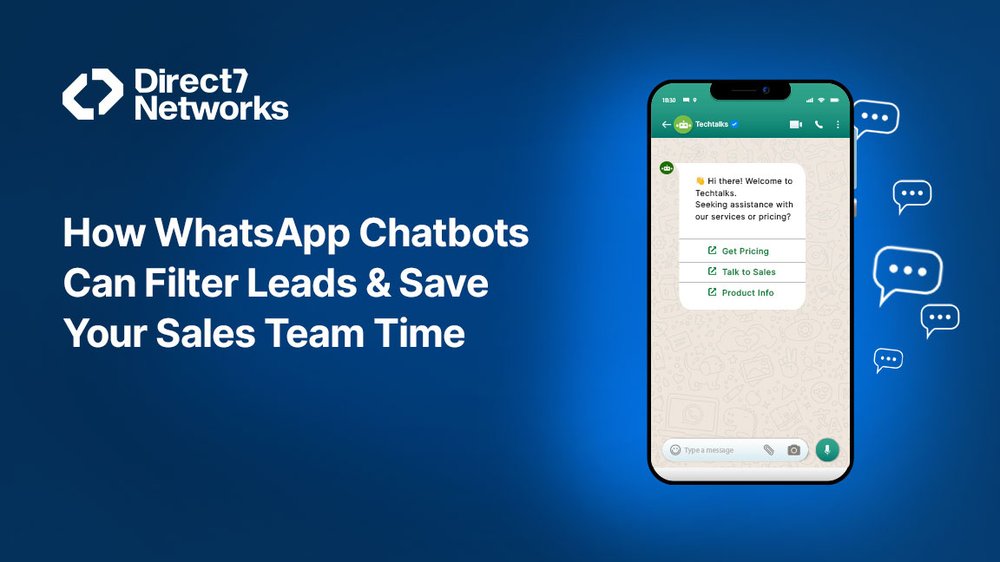

How WhatsApp Chatbots Can Filter Leads & Save Your Sales Team Time
Most businesses become unsuccessful not because they lack leads they fail because their sales teams spend too much time talking to the wrong ones. Every week, valuable sales hours are wasted on unfinished inquiries, unqualified prospects, or people who are simply not ready to buy. This is where a WhatsApp chatbot becomes more than a convenience feature. It becomes a lead-filtering engine sorting, qualifying, and routing prospects before a human ever joins the conversation.
This article explains:
❖ How WhatsApp chatbots streamline lead filtering
❖ Why they are becoming a core component of modern sales funnels
❖ How smart businesses convert automation into real revenue
1.0 Why WhatsApp Is the Perfect Lead-Filtering Channel
1.0 Why WhatsApp Is the Perfect Lead-Filtering Channel
Effective lead filtering requires one thing above all else: responses. If prospects don’t reply, qualification fails. WhatsApp succeeds precisely because people actually engage on it.
1.1 What Makes WhatsApp Ideal for Lead Qualification
❖ High daily usage
People check WhatsApp dozens of times a day, making messages hard to miss.
❖ Personal and conversational
Chats feel natural, not transactional like forms or emails.
❖ Exceptionally high response rates
Engagement is dramatically higher than email, landing pages, or contact forms.
❖ Built for guided conversations
Supports quick replies, buttons, and structured flows that make qualification effortless.
1.2 WhatsApp vs Traditional Lead Capture
| Channel | Common Problem | Result |
|---|---|---|
| Web Forms | High abandonment | High abandonment |
| Low open & reply rates | Slow follow-up | |
| Phone Calls | Ignored unknown numbers | Missed connections |
| Conversational & instant | Active engagement |
Unlike web forms that lose half of visitors before submission, WhatsApp keeps the conversation alive. The chatbot asks structured questions, users respond casually, and qualification happens naturally in real time.
1.3 How Automated Lead Filtering Works
Step-by-Step Flow
- Prospect clicks an ad, form, or link
- WhatsApp chat opens instantly
- Chatbot asks qualifying questions (need, budget, timeline)
- Responses are analyzed automatically
- Only qualified leads are routed to sales
Sales teams receive fewer conversations but far better ones.
Summary: WhatsApp combines high engagement with structured automation, making it the most effective channel for lead filtering in modern sales funnels.
2.0 What Lead Filtering Really Means and Why It Matters
Many businesses mistakenly treat lead capture and lead qualification as the same thing. They are not. A WhatsApp chatbot can perform both but its real power lies in filtering, not just collecting data.
2.1 Lead Capture vs Lead Filtering
Lead Capture
This is the basic collection of information:
❖ Name
❖ Phone number
❖ Area of interest
❖ Budget (if provided)
❖ Other basic details
Capture tells you who contacted you but not whether they’re worth pursuing.
Lead Filtering / Qualification
This is where real value is created. Leads are sorted into clear buckets:
❖ Ready to buy soon
❖ Interested but needs nurturing
❖ Wrong fit / low priority
❖ Spam or irrelevant enquiries
Filtering tells you who deserves sales time and who does not.
2.2 Why Lead Filtering Saves Sales Teams So Much Time
Without filtering, sales teams repeat the same questions over and over:
❖ What do you need?
❖ What’s your budget?
❖ When are you planning to buy?
❖ Are you the decision-maker?
A WhatsApp chatbot handles this instantly 24/7, with:
❖ Consistent logic
❖ Zero fatigue
❖ No delays
Instead of manual back-and-forth, sales teams receive pre-qualified, context-rich conversations.
Summary: Lead filtering shifts sales work from “question asking” to “deal closing.”
3.0 How WhatsApp Chatbots Filter Leads Step by Step
A well-designed WhatsApp chatbot including those built using platforms like D7 Networks filters leads naturally, without making the experience feel robotic or intrusive.
3.1 Step 1: Start the Conversation Immediately
❖ No waiting.
❖ No follow-up delays.
❖ The chatbot greets the visitor instantly.
It asks a simple opening question and sets expectations for a guided conversation.
Why it works: Speed builds momentum and prevents drop-offs.
3.2 Step 2: Collect Structured Data
The chatbot asks the same questions your sales team would but in a cleaner, more consistent way:
❖ What problem are you trying to solve?
❖ What’s your expected budget?
❖ How urgently do you need a solution?
❖ How many users, locations, or customers are involved?
Because answers are structured, downstream routing becomes effortless.
Why it works: Clean inputs = clean handoffs to sales.
3.3 Step 3: Score the Lead Automatically
Using predefined rules, the chatbot evaluates lead quality based on:
❖ Budget tier
❖ Purchase timeline
❖ Product or service fit
❖ Industry or geography
❖ Intent signals
➢ Clicking product links
➢ Viewing pricing pages
➢ Requesting demos
Each signal contributes to a lead score.
Why it works: Scoring replaces guesswork with logic.
3.4 Step 4: Route High-Value Leads Instantly
When a lead scores high, automation kicks in:
❖ Push the lead to a sales representative
❖ Send a calendar or meeting link
❖ Notify the sales team inside the CRM
This is where CRM integrations (e.g., Zapier, Make,Active Campaign ) deliver maximum impact.
Why it works: Sales teams engage while interest is at its peak.
3.5 Step 5: Nurture Low-Intent or Early-Stage Leads
Not every lead is ready to buy and that’s fine.
Instead of discarding them, the chatbot can:
❖ Add them to a WhatsApp drip sequence
❖ Share a guide, case study, or pricing sheet
❖ Re-engage after a few days or weeks
The chatbot becomes a mini nurturing engine, keeping leads warm without manual effort.
Why it works: Long-term value is preserved without sales pressure.
3.6 Step 6: Block Time-Wasters and Spam
Chatbots can automatically identify and filter out:
❖ Incomplete or evasive responses
❖ Fake or invalid numbers
❖ Non-serious or irrelevant inquiries
These never reach your sales team.
Why it works: Sales focus stays protected and productive.
Section Summary
WhatsApp chatbots transform lead filtering from a manual, repetitive task into a smart, automated system. By qualifying, scoring, routing, nurturing, and filtering leads before humans step in, businesses save time, improve conversion rates, and let sales teams focus on what they do best closing deals.

4.0 Where D7 Networks Fits In
To make lead filtering reliable at scale, businesses need more than just a chatbot — they need infrastructure that supports automation, routing, and integrations without friction. This is where D7 Networks plays a critical role.
4.1 Capabilities That Enable Scalable Lead Filtering
D7 Networks supports WhatsApp chatbot automation and lead-qualification workflows through:
● Fast WhatsApp API setup
Rapid onboarding without long implementation cycles.
● Template approvals
Compliance-ready message templates for outbound and transactional flows.
● Flow-builder capabilities
Visual, logic-driven workflows for qualification, scoring, and routing.
● CRM integrations
Seamless syncing with platforms like Zapier, Zoho, and Make.
● High-deliverability infrastructure
Ensures messages reach users reliably, even at high volume.
Summary: D7 Networks ensures your lead-filtering logic works consistently, reliably, and at scale without operational bottlenecks.
5.0 Mistakes Businesses Should Avoid
Even the best chatbot strategies fail when fundamentals are overlooked. Lead-filtering automation must feel natural, helpful, and purposeful.
5.1 Common Pitfalls in Lead-Filtering Chatbots
1. Asking Too Many Questions Upfront
❖ Why it’s a problem: Users drop off when conversations feel exhausting.
❖ How to avoid: Start with 2–3 high-impact questions and expand only if intent is clear.
2. Using Complex or Technical Language
❖ Why it’s a problem: Confuses users and reduces response rates.
❖ How to avoid: Keep language simple, friendly, and conversational.
3. Making the Bot Sound Too Formal
❖ Why it’s a problem: Feels robotic and discourages engagement.
❖ How to avoid: Write messages the way a helpful human would speak.
4. Not Offering Human Handover
❖ Why it’s a problem: High-intent leads get frustrated without escalation.
❖ How to avoid: Always provide a clear path to a live agent or sales rep.
5. Not Syncing Data with the CRM
❖ Why it’s a problem: Leads lose context, forcing sales teams to start from scratch.
❖ How to avoid: Push all conversations, scores, and tags into your CRM automatically.
6. No Clear Follow-Up Action per Lead Category
❖ Why it’s a problem: Leads fall into limbo.
❖ How to avoid: Define explicit next steps for high-, medium-, and low-intent leads.
Key Principle: A lead-filtering chatbot should feel like a c onversation not a form disguised as chat.
6.0 Conclusion: Lead Filtering on WhatsApp Isn’t a Trend It’s a Competitive Advantage
❖ WhatsApp chatbots don’t merely automate conversations.
They restructure your sales funnel.
❖ They separate noise from opportunity.
They protect your sales team’s time.
They turn scattered, unstructured inquiries into clean, qualified leads.
For businesses that prioritize speed, clarity, and consistency especially in regions where WhatsApp is the dominant communication channel chatbot-based lead filtering is no longer optional.
Final Takeaway:
If your sales team is overwhelmed, automation isn’t the problem lack of filtering is.
WhatsApp chatbots give you that filter, and businesses that adopt it early gain a lasting competitive edge.