
SMPP vs HTTP SMS: Which SMS Protocol Should You Choose?
A product team is preparing to launch a two-factor authentication system for millions of users. The developers need SMS delivery that’s fast, reliable, and capable of handling sudden traffic spikes. Meanwhile, the infrastructure team is asking a different question: Should we integrate through an HTTP SMS API or connect directly via SMPP?
This is a common decision for businesses building messaging infrastructure. The protocol you choose determines how quickly messages move through the system, how easily your developers can integrate the platform, and how well your messaging stack scales as traffic grows.
Two protocols dominate most SMS platforms today: SMPP and HTTP SMS APIs. Each solves the same core problem, delivering messages to mobile networks, but they do it in very different ways.
Understanding the difference is essential when designing reliable SMS delivery architecture.
What Are SMS Delivery Protocols?
Whenever a business sends an SMS, whether it's a banking alert, OTP code, or marketing campaign, the message travels through an SMS gateway before reaching the mobile network.
The gateway acts as the bridge between applications and telecom operators.
Applications communicate with these gateways using SMS delivery protocols. These protocols define how messages are submitted, queued, tracked, and confirmed.
Most modern messaging platforms support two integration methods:
- HTTP-based APIs
- SMPP connections
Both approaches are part of broader messaging infrastructure discussed in advanced SMS delivery protocols. These systems manage routing, delivery reports, retries, and carrier connectivity across global networks.
At a high level:
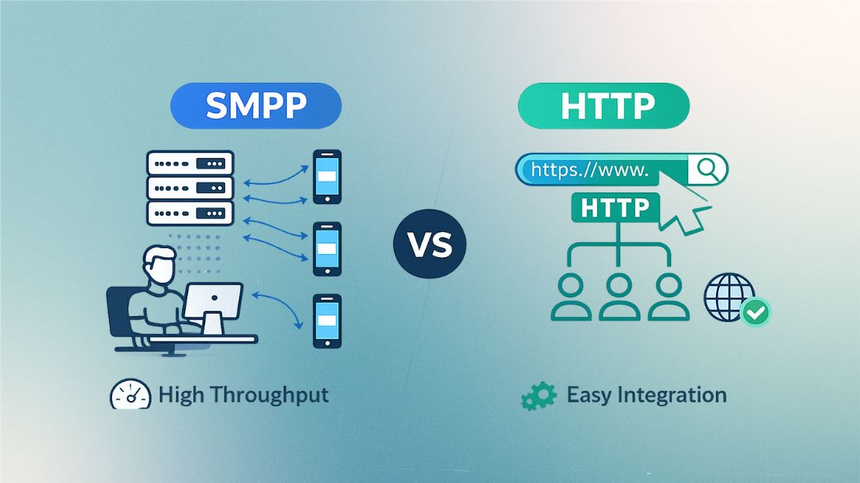
- HTTP APIs prioritize simplicity
- SMPP prioritizes throughput and telecom-level performance
What Is SMPP?
SMPP (Short Message Peer-to-Peer) is a telecom messaging protocol originally designed for direct communication between SMS centers (SMSC) and messaging systems.
It’s widely used by:
- SMS aggregators
- telecom operators
- enterprise messaging platforms
How SMPP Works
SMPP operates over persistent TCP connections.
Instead of sending one message request at a time, the connection stays open, allowing systems to push thousands of messages continuously without reconnecting.
Typical SMPP workflow:
- Application opens an SMPP session with the SMS gateway
- Messages are submitted using bind/transmit operations
- Gateway responds with message IDs
- Delivery receipts are returned asynchronously
Because the connection stays open, the system can send many messages per second.
Advantages of SMPP
High throughput
SMPP can handle extremely large message volumes. A single connection may process hundreds of messages per second depending on configuration.
Low latency
Persistent connections reduce overhead from repeated authentication or connection setup.
Telecom-grade reliability
Most carrier networks natively support SMPP, making it the standard protocol for operator integrations.
Asynchronous delivery reports
Delivery receipts arrive independently, which works well for large messaging systems.
Limitations
Complex implementation
SMPP requires session management, sequence tracking, and message windowing.
Infrastructure requirements
Businesses often need specialized libraries, monitoring systems, and message queues.
Not ideal for small applications
For lower messaging volumes, SMPP can introduce unnecessary operational complexity.
What Is HTTP SMS API?
HTTP-based SMS APIs allow applications to send messages using simple web requests.
Instead of maintaining persistent sessions, applications send standard HTTP requests to an SMS gateway endpoint.
Example flow:
- Application sends an HTTP request
- Gateway receives the message payload
- Gateway routes the SMS to the carrier network
- Delivery reports are returned via API callbacks or polling
Developers can integrate these APIs in minutes using common tools like:
- REST clients
- Server-side frameworks
- Simple scripting environments
Advantages of HTTP SMS APIs
Easy integration
Most developers already work with REST APIs. Sending SMS becomes as simple as making a POST request.
Faster implementation
Businesses can integrate messaging into applications without telecom expertise.
Flexible deployment
HTTP APIs work well with cloud infrastructure and microservices.
Lower operational complexity
No persistent connections or session handling are required.
Limitations
Lower throughput
HTTP connections introduce overhead compared to persistent SMPP sessions.
Higher latency under heavy load
Each message request requires processing and authentication.
Scaling challenges for massive campaigns
Large messaging platforms may eventually hit throughput limitations.
Typical Users
HTTP SMS APIs are commonly used by:
- SaaS platforms
- Startups
- Web applications
- CRM systems
- Authentication platforms
SMPP vs HTTP API: Key Differences
| Feature | SMPP | HTTP API |
|---|---|---|
| Connection type | Persistent TCP connection | Stateless HTTP requests |
| Throughput | Very high (hundreds+ messages/sec) | Moderate |
| Complexity | High | Low |
| Use cases | Telecom infrastructure, bulk messaging | Application messaging |
| Scalability | Designed for large-scale delivery | Scales with API infrastructure |
| Implementation time | Longer | Very fast |
The decision usually comes down to message volume, operational expertise, and scaling requirements.
Performance Comparison (Speed & Throughput)
Performance differences between SMPP vs HTTP SMS become more noticeable as message volume increases.
Throughput
SMPP is built for high throughput. Persistent connections allow systems to send messages continuously without re-establishing network sessions.
Example scenarios:
OTP delivery systems
- Typically moderate traffic
- HTTP APIs usually perform well
Marketing SMS campaigns
- Thousands or millions of messages
- SMPP provides higher sustained throughput
Banking alerts
- High reliability requirements
- Often run on SMPP infrastructure
Latency
HTTP APIs may introduce slightly higher latency because each request must:
- Establish a connection
- authenticate
- process the request
SMPP avoids this overhead through persistent sessions.
Batching
SMPP systems can queue and pipeline messages efficiently. This is why large SMS aggregators rely heavily on SMPP connections when managing massive campaigns.
Which Protocol Should Your Business Choose?
The best protocol depends on how your business sends messages today—and how it expects to scale tomorrow.
Choose HTTP API if
- Your developers need fast integration
- Messaging volume is low to moderate
- Your application runs on web or cloud infrastructure
- You want minimal telecom complexity
This approach works well for:
- SaaS platforms
- Authentication systems
- Customer notifications
- CRM messaging tools
Choose SMPP if
- You send very high message volumes
- You operate telecom infrastructure
- You run large-scale SMS campaigns
- Your team can manage persistent messaging sessions
Organizations that benefit most from SMPP include:
- SMS aggregators
- Telecom carriers
- Global enterprise messaging platforms
Hybrid Messaging Architecture
Many modern messaging platforms combine both protocols.
The idea is simple:
- HTTP APIs for developer-friendly integrations
- SMPP connections for high-volume message routing
This hybrid approach allows businesses to scale messaging infrastructure gradually.
Enterprise messaging providers like Direct7 Networks support both protocols, so customers can integrate through HTTP APIs while the platform manages SMPP routing to carrier networks behind the scenes.
For developers and product teams, this means simplicity at the integration layer while maintaining telecom-grade performance.
If you're exploring messaging infrastructure in more depth, a good starting point is a business SMS platform overview, which explains how these components fit together inside modern messaging platforms.
Common Mistakes When Choosing SMS Protocols
Businesses often run into problems when protocol decisions are made too early in the architecture process.
Choosing SMPP Too Early
Some teams adopt SMPP because it sounds more powerful. But if messaging volume is low, HTTP APIs usually provide the same results with far less operational overhead.
Ignoring Infrastructure Complexity
SMPP requires:
- Session management
- Message window control
- Error handling
- Delivery receipt tracking
These systems need monitoring and maintenance.
Underestimating Scaling Needs
The opposite mistake also happens.
Startups sometimes launch with simple APIs and later discover their infrastructure struggles when campaigns scale to millions of messages.Planning for growth early can prevent costly migrations.
Not Planning Delivery Throughput
Messaging performance depends on more than protocol choice.
Other factors include:
- SMS gateway capacity
- Routing logic
- Carrier connections
- Queue management
Protocol choice is just one piece of the messaging architecture.
The Practical Takeaway
The debate around SMPP vs HTTP SMS is really about scale and complexity. HTTP APIs work extremely well for most applications. They’re simple to integrate, flexible, and reliable for everyday messaging use cases. SMPP becomes valuable when messaging volume reaches telecom-level scale. Persistent connections and higher throughput make it ideal for aggregators, carriers, and enterprise messaging systems. Many modern platforms combine both approaches, allowing businesses to start simple and scale their infrastructure as messaging demand grows. The right protocol is the one that fits your current architecture while leaving room for future scale.