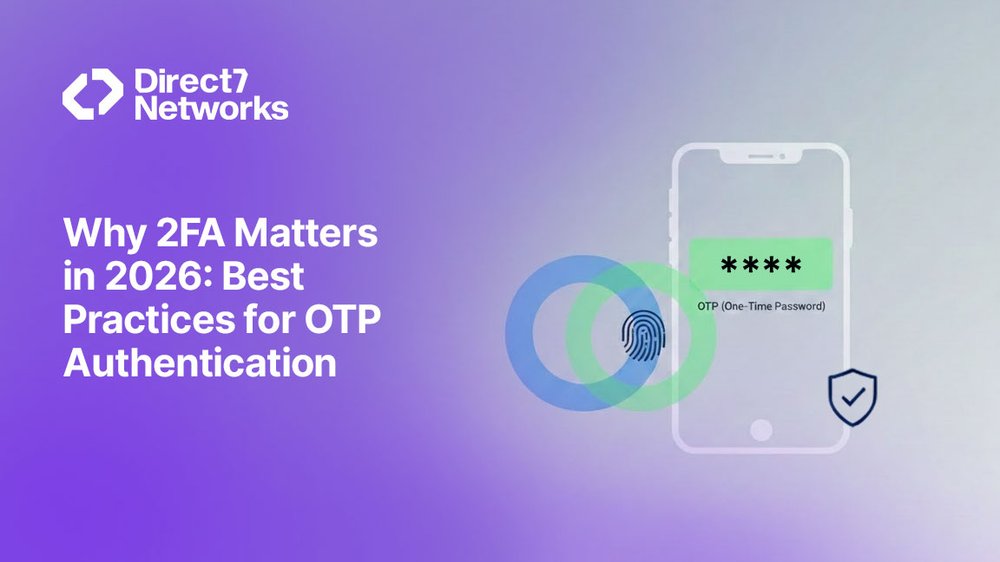

Why 2FA Matters in 2026: Best Practices for OTP Authentication
Security habits rarely keep pace with digital threats. Even in 2026, users continue to reuse passwords, fall for phishing attacks, and underestimate how easily weak authentication systems can be breached. This gap is precisely why two-factor authentication (2FA) remains one of the most effective defenses against account compromise.
At the same time, 2FA itself has evolved. Businesses now operate in a landscape shaped by:
- More sophisticated fraud techniques
- Stricter compliance requirements
- Global user bases
- Customers who expect verification to be fast and frictionless
One-time password (OTP) authentication, especially via SMS and messaging channels, continues to be one of the most accessible ways to add security, provided it’s implemented correctly.
This article explains why 2FA still matters in 2026, how the threat landscape has changed, and the best practices organizations should follow to keep authentication both secure and user-friendly.
Why 2FA Still Matters in 2026
Passwords Remain the Weakest Link
Despite years of data breaches and security awareness campaigns, password behavior hasn’t improved much. Attackers continue to exploit:
- Password reuse across platforms
- Leaked credentials from previous breaches
- Simple dictionary-based passwords
- Automated credential-stuffing tools
Even a strong password becomes useless once it’s stolen. 2FA adds a second barrier, one that attackers can’t bypass with a single leaked credential.
Cyberattacks Are Now Fully Automated
Modern attacks don’t rely on manual attempts. Automated tools continuously:
- Scan login endpoints
- Test credentials at scale
- Rotate IPs to avoid detection
In this environment, 2FA acts as an immediate brake. An attacker who only has a password simply can’t proceed without the second factor.
Remote Work Expanded the Attack Surface
Distributed teams, shared devices, and multi-region access have made suspicious logins harder to detect using location or device patterns alone.
As a result, companies increasingly rely on OTP verification to confirm identity before granting access to:
- Admin dashboards
- Financial systems
- Internal tools
- Sensitive customer data
2FA has become a baseline control for modern work environments, not an optional feature.
Fraud Is Rising Across High-Growth Industries
Industries such as fintech, e-commerce, mobility, logistics, and healthcare have seen a sharp rise in account takeovers and fraudulent activity.
In many of these cases, 2FA remains:
- The fastest security upgrade to deploy
- The most universal method across devices
- The least disruptive option for onboarding users
When implemented properly, OTP-based 2FA blocks a large percentage of attacks without adding unnecessary friction.
Why OTP Authentication Still Dominates in 2026
Despite the rise of new authentication methods, OTP-based verification continues to be the most widely adopted approach in 2026. Its strength lies not in complexity, but in accessibility, speed, and practicality.
1. Universal Device Reach
Not every user installs authenticator apps.
Not everyone checks email consistently.
But nearly everyone can receive an SMS.
This makes OTP authentication the most inclusive option across regions, devices, and user demographics, especially in markets where smartphones vary widely in capability.
2. Fast and Frictionless Onboarding
Users joining a new platform expect verification to be quick and intuitive. Long setup steps or unfamiliar security flows increase abandonment.
OTP keeps onboarding simple:
- One input field
- One code
- Immediate access
This is particularly effective in mobile-first journeys and developing markets, where ease of use directly impacts conversion.
3. Works Without Apps or Configuration
OTP requires:
- No downloads
- No app installation
- No configuration or training
It works instantly on any device, which helps keep drop-off rates low and adoption high—especially for first-time users.
4. Stronger When Paired With Best Practices
OTP alone isn’t enough if implemented poorly. However, when combined with:
- Smart delivery routing
- Fraud detection and rate limiting
- Reliable messaging infrastructure
…it becomes both secure and highly effective.
When supported by dependable providers such as D7 Networks, OTP authentication strikes the right balance for businesses in 2026: strong security without sacrificing user experience.
Best Practices for OTP Authentication in 2026
OTP authentication remains effective in 2026, but only when it’s implemented correctly. The following best practices help balance security, speed, and user experience in modern authentication systems.
1. Use Short Expiration Windows
Short-lived OTPs significantly reduce the risk of interception and replay attacks.
Recommended controls:
- OTP expiry: 30–90 seconds
- Maximum attempts: 3 per OTP
- Auto-expire OTPs after a device or browser change
The shorter the window, the smaller the opportunity for misuse.
2. Implement Strong Rate Limiting
Attackers often request OTPs repeatedly to overwhelm systems or exploit patterns.
Effective rate-limiting measures include:
- A maximum number of OTP requests per user per hour
- Cooldown periods after repeated failed attempts
- Automated alerts for unusual request spikes
Rate limiting protects both users and infrastructure from abuse.
3. Validate Phone Numbers Before Sending OTPs
Sending OTPs to invalid or risky numbers wastes resources and creates security gaps.
Number Lookup APIs help by:
- Verifying whether a number is valid and reachable
- Detecting risky or disposable numbers
- Reducing unnecessary OTP traffic
This improves delivery rates and lowers costs. Platforms like D7 Networks include number validation as part of the verification workflow.
4. Use Trusted Routing and Delivery Paths
OTP delivery must be fast and reliable—every second matters.
Avoid low-quality or grey routes that cause delays and failed logins. Always prioritize:
- Direct operator routes
- Registered sender IDs
- Local and regulatory-compliant messaging paths
Reliable routing directly impacts both security and user trust.
5. Avoid Predictable OTP Patterns
Security depends on randomness.
Ensure your OTP system uses:
- Six-digit codes
- Cryptographically secure generation
- No sequential, repeating, or guessable patterns
Predictable OTPs undermine the entire authentication flow.
6. Use Secure, Clear Message Templates
Well-structured OTP messages reduce confusion and phishing risk.
Example template:
Your D7 verification code is 418392. It expires in 60 seconds. Do not share this code with anyone.
Key template rules:
- Keep messages short and direct
- Avoid clickable links in OTP messages
- Clearly mention your brand name
Clarity builds trust and prevents social engineering attempts.
7. Add Device and Behavior Intelligence
Modern authentication doesn’t rely on OTPs alone. Risk-based signals improve decision-making.
Common signals include:
- IP reputation
- Device fingerprinting
- Login velocity
- Location mismatch
- SIM swap detection
These signals help determine when OTP is sufficient—and when additional verification steps are required.
8. Monitor Delivery Receipts in Real Time
Real-time visibility is essential for both security and performance.
Delivery monitoring helps you identify:
- Whether OTPs are actually reaching users
- Regional or carrier-specific delivery issues
- Patterns that indicate fraud or OTP abuse
Reliable messaging providers such as D7 Networks offer detailed delivery receipts and analytics, allowing routing adjustments in real time.
Final Note
In 2026, OTP authentication is no longer just about sending a code. It’s about how fast, how securely, and how intelligently that code is delivered.
When these best practices are applied together, OTP remains one of the most dependable and user-friendly security layers available today.
Real-World OTP Use Cases in 2026
OTP authentication continues to play a critical role across industries where security, speed, and accessibility must coexist.
Fintech Onboarding and Transactions
OTP remains essential for identity verification, approving sensitive actions, and confirming payments, especially in high-risk financial transactions where fraud prevention is critical.
eCommerce Login and Checkout
To reduce fake accounts, minimize cart abandonment, and secure high-value purchases, eCommerce platforms now apply OTP at specific, high-impact touchpoints rather than everywhere.
Healthcare and Teleconsultation Access
Access to medical records and virtual consultations involves highly sensitive data. OTP ensures that only verified users can view or interact with personal health information.
Government and Education Portals
Public services and educational platforms increasingly rely on mobile-first authentication. In regions where smartphones are the primary device, OTP provides a simple and inclusive way for citizens and students to log in securely.
Common Mistakes Businesses Still Make
Even in 2026, many organizations weaken their OTP flows by overlooking basic principles.
Sending OTPs without proper consent
Always ensure users have explicitly opted in before receiving authentication messages.
Using long OTP validity windows
Extended expiry times increase the risk of interception and misuse.
Mixing promotional content with OTP messages
OTP messages should be strictly transactional. Marketing text creates confusion and raises phishing risks.
Using unreliable or low-quality delivery routes
Cheap routes lead to delays, failed verifications, and poor user experience.
Failing to monitor delivery issues
Without delivery tracking, teams can’t detect failures, fraud attempts, or regional issues in time.
Requiring OTP too frequently
Overuse leads to user fatigue and abandonment. OTP should appear only when the risk justifies it.
Avoiding these pitfalls is just as important as implementing 2FA itself. When OTP is applied thoughtfully and responsibly, it remains one of the most effective authentication tools available in 2026.
Conclusion
Security in 2026 isn’t just about stronger systems; it’s about smarter, more intentional authentication.
Despite the emergence of new security technologies, two-factor authentication remains essential. Attackers still target weak entry points, and users continue to rely on vulnerable passwords. That reality hasn’t changed.
When implemented with modern best practices, OTP authentication offers an ideal balance of security, accessibility, and speed.
Start with the fundamentals:
- Use reliable routing and delivery infrastructure
- Keep OTP expiry windows short
- Validate phone numbers before sending codes
Review authentication flows regularly, and treat 2FA as an evolving part of your platform, not a set-and-forget feature. When implemented correctly and supported by a trusted delivery partner, strong authentication delivers a seamless user experience without compromising system security.