
10 Best WhatsApp Messages for E-commerce in 2026
A customer clicks “Buy Now,” gets distracted, and disappears. Another adds three items to the cart but hesitates at checkout. A third buys once and never returns.
These are everyday moments in e-commerce and they’re exactly where WhatsApp messages are quietly outperforming email and push notifications. In 2026, the difference isn’t just speed or open rates. It’s how natural the interaction feels. The best-performing brands don’t send messages they create conversations that guide customers forward.
Here are 10 WhatsApp message types that consistently drive conversions, retention, and customer trust along with practical examples you can adapt right away.
Why Message Quality Matters More Than Volume
There's a common mistake e-commerce teams make: treating WhatsApp like a broadcast channel for promotions. That's a fast way to get blocked. WhatsApp users treat the app differently from email,it's where they talk to friends and family. Intrusive or irrelevant messages get reported, and a high block rate damages your sender quality rating with Meta.
The brands that win on WhatsApp share one trait: they send messages customers actually want to receive. Every template below is built around that principle, relevance, timing, and a tone that feels personal without being fake.
The 10 Message Types That Drive Real Results
1. The Order Confirmation
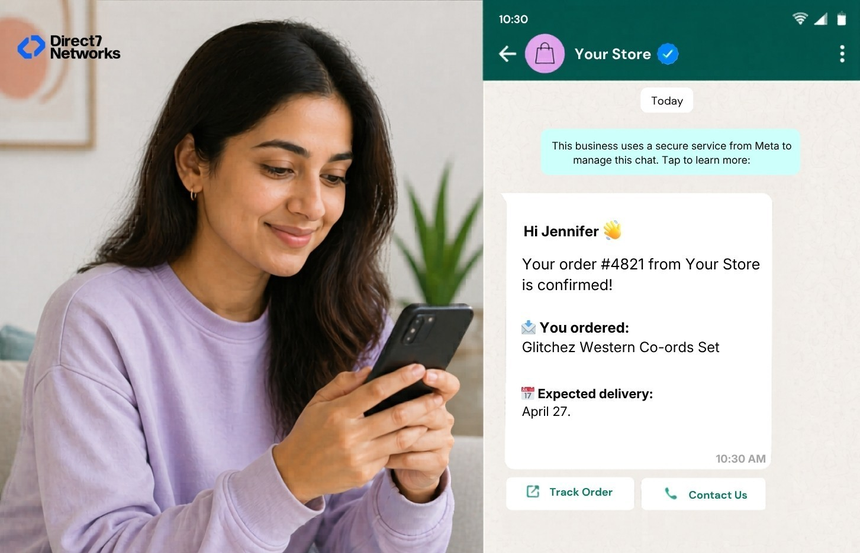
The first message a customer expects after purchase. Done badly, it's a dry receipt. Done well, it sets the tone for the entire relationship.
Hi Jennifer👋 Your order #4821 from [Brand] is confirmed! You ordered: Glitchez Western Co-ords Set. Expected delivery: April 27. Track your order here: [link]
Keep it warm, specific, and useful. Include the product name, not just the order ID, so customers don't have to log in to remember what they bought.
2. Shipping Update with a Human Touch
Shipping notifications are the most-opened messages in e-commerce. Customers are anxious; a timely update builds confidence.
Good news, Karan! Your order is on its way 🚚 It left our warehouse today and should reach you by April 27. Your tracking ID: [ID] — [Carrier] link: [url]
The mistake most brands make here is sending only one update. Send three: when dispatched, when out for delivery, and when delivered. Each touchpoint is a chance to reinforce trust.
3. Out-for-Delivery Alert
This one has an almost immediate open rate because customers are literally waiting. Use it to also reduce failed deliveries.
Your [Brand] order is out for delivery today! 🎉 Our delivery partner will arrive between 2 PM – 6 PM. Someone home? If not, reply RESCHEDULE and we'll arrange a new slot.
Adding a simple action — "reply RESCHEDULE" , reduces missed deliveries and the support tickets they generate.
4. Abandoned Cart Recovery
Between 50–70% of online shoppers add items to their cart and don't check out. A single WhatsApp nudge, sent within 30–60 minutes, can recover a meaningful portion of that.
Hey Alex, you left something behind 👀 Your cart has: [Product Name] only [X] left in stock. Still interested? [Complete Purchase →]
Two things matter here: speed and specificity. Generic "you left items in your cart" messages underperform. Name the product. If inventory is low, say so honestly scarcity that's real converts; scarcity that's fabricated destroys trust.
5. Back-in-Stock Notification
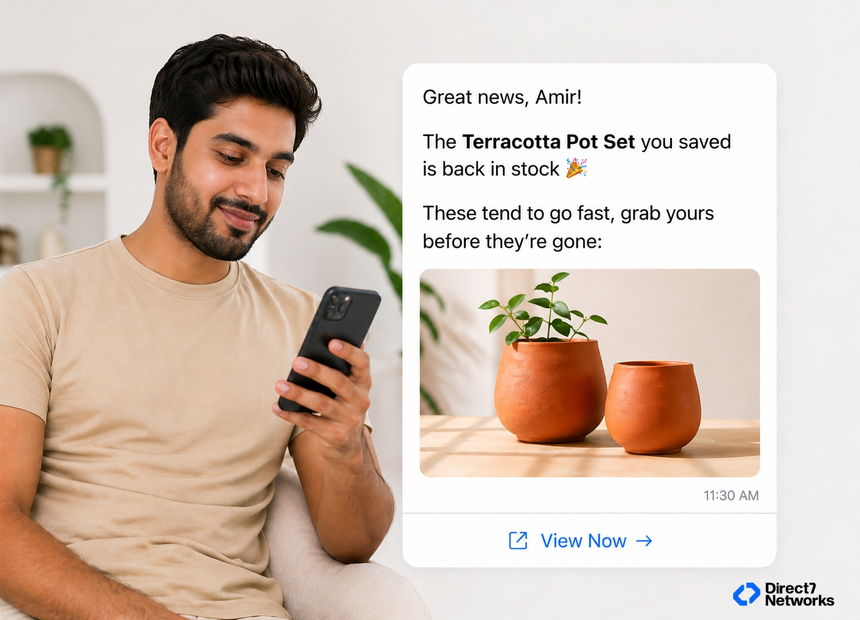
If a customer previously viewed or wishlisted a product that was out of stock, a back-in-stock message is one of the highest-intent touchpoints you can send.
Great news, Peter! The Terracotta Pot Set you saved is back in stock 🎉 These tend to go fast, grab yours before they're gone: [View Now →]
This only works if your system is actually tracking wish lists and product interest. If it isn't, that's a worthwhile integration to prioritise.
6. Post-Purchase Review Request
Most customers who had a good experience won't leave a review unless prompted. The best time to ask is 3–5 days after delivery, enough time to use the product, not so long that the memory fades.
Hi Natasha, hope your [Product Name] arrived safely! We'd love to hear what you think. Your honest review helps other shoppers and helps us improve. Takes 30 seconds: [Leave a Review →]
The key phrase is "honest review." It signals confidence and makes customers more likely to trust and respond to your ask.
7. Loyalty and Repeat Purchase Offer
Acquiring a new customer costs 5–7x more than retaining one. Yet most WhatsApp strategies ignore post-purchase re-engagement entirely.
Hey Olivia 👋 It's been a month since your last order. We've restocked your favourites and added some new arrivals. As a returning customer, here's 10% off your next order valid for 48 hours: [LOYAL10] → [Shop Now]
Personalise with the customer's name and purchase history. A message that says "we noticed you" converts far better than a blanket discount blast.
8. Flash Sale Announcement
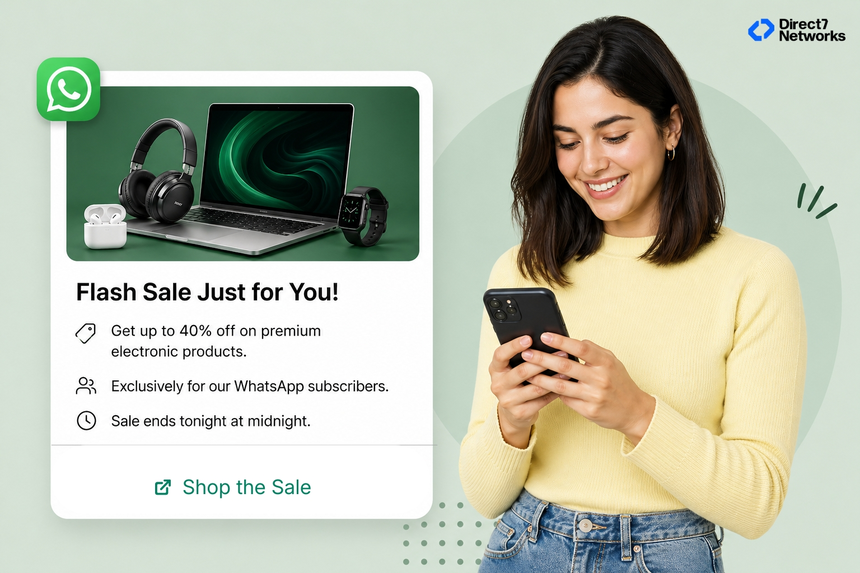
Promotional messages on WhatsApp work, but only when they're infrequent enough to feel special. If you're sending three promos a week, you'll quickly lose the goodwill of your subscriber list.
⚡ 4-Hour Flash Sale — Starts Now! Up to 40% off on [Category]. Only for WhatsApp subscribers. Ends at midnight: [Shop the Sale →]
The "only for WhatsApp subscribers" framing matters. It makes the channel feel exclusive, which increases both opt-ins and engagement. Platforms like D7 Networks make it straightforward to segment and schedule these blasts at scale through the WhatsApp Business API.
9. Proactive Support Message
When there's a delay, a stock issue, or a courier problem,don't wait for the customer to reach out. Get ahead of it.
Hi Kavya, just a heads-up: your order #6102 is running a day late due to logistics in your area. New expected delivery: April 29. Sorry for the inconvenience, and here's a 5% credit on your next order as a thank you for your patience: [Code: WAIT5]
Proactive communication reduces inbound support volume significantly and turns a negative experience into a loyalty-building moment. Customers who receive a sincere heads-up before they discover a problem are far more forgiving than those who have to chase you for answers.
10. Re-engagement for Lapsed Customers
Customers who haven't purchased in 60–90 days need a different kind of message less transactional, more conversational.
Hey Sana, it's been a while 👋 We've been busy adding new [category] you might love. What's your vibe right now — [Option A] or [Option B]? Tap to explore: [link]
The two-option format works well because it invites a response without demanding one. It also helps your team understand what customers actually want to see, which improves future targeting.
A Simple Framework to Build on
These 10 message types map neatly onto three stages of the customer journey:
Before purchase: Flash sales, cart recovery, back-in-stock alerts.
During fulfillment: Order confirmation, shipping updates, out-for-delivery alerts.
After delivery: Review requests, loyalty offers, re-engagement, proactive support.
If you're just starting, build the fulfillment layer first. Those messages are expected, welcome, and low-risk. Once your audience trusts the channel, layer in the promotional and re-engagement messages.
One Thing Worth Getting Right Before Anything Else
Every WhatsApp Business API message requires opt-in consent. Before you send anything, make sure your customers have explicitly agreed to receive WhatsApp communications, via checkout, a web form, or an SMS confirmation. This isn't just a compliance requirement; it's what keeps your messages in the "trusted" category rather than spam.
The brands seeing the strongest results from WhatsApp in 2026 aren't necessarily the ones with the most messages. They're the ones who've built a list of genuinely interested customers and send messages those customers are glad to receive.