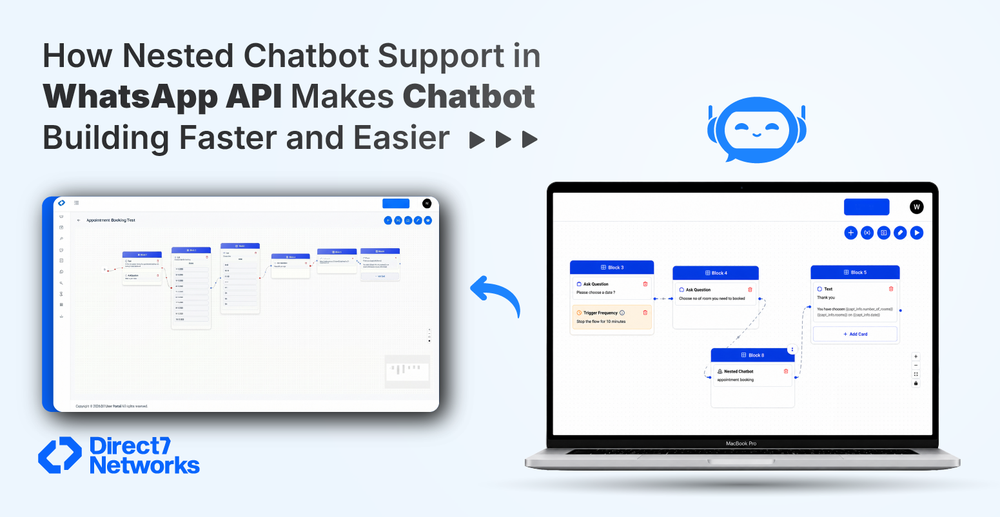
How Nested Chatbot Support in WhatsApp API Makes Chatbot Building Faster and Easier
Learn how reusable chatbot flows in WhatsApp API simplify chatbot building, improve consistency, and reduce maintenance effort.
Most businesses don’t build just one chatbot anymore.
A retail company may have separate WhatsApp flows for support, order tracking, payments, promotions, and lead generation. A healthcare provider may run appointment booking, prescription reminders, and patient onboarding through different chat experiences. Even smaller teams often manage multiple chatbot journeys across departments.
The problem starts when the same conversation flow appears again and again.
Every chatbot asks for common information like preferred language, delivery address, email ID, customer consent, or OTP verification. Teams usually recreate these flows manually inside every bot. That means duplicate work, inconsistent user experiences, and more maintenance every time something changes.
Nested chatbot support in WhatsApp API solves this in a much cleaner way.
Instead of rebuilding the same flow repeatedly, teams can create reusable chatbot components once and plug them into multiple WhatsApp chatbot journeys whenever needed.
It sounds like a small improvement at first. In practice, it changes how chatbot systems are designed, maintained, and scaled.
What "Nested Flows" Actually Means
The term sounds technical, but the concept is straightforward. Think of a nested flow as a self-contained conversation module that handles one specific task: collecting a delivery address, letting a user pick their preferred language, confirming consent, and verifying an OTP. You build it once, test it thoroughly, and then call it from other chatbots whenever that task needs to happen.
The parent chatbot handles the main conversation. When it hits a point that requires, say, a delivery address, it hands control to the nested address flow. That flow collects the information, validates it, and passes the result back to the parent bot, which then continues the conversation.
This is very similar to how developers use functions or components in code; you don't rewrite a login form every time you build a new page. You reuse it. Nested chatbot support brings the same thinking to conversational design.
Why This Matters More Than It Seems
The real impact isn't just saving build time on the first round. It shows up in three places teams often underestimate.
Consistency across touchpoints - When your sales bot and your support bot both pull from the same address collection flow, customers get an identical experience regardless of where they start the conversation. There's no "the support bot asked me this differently" confusion.
Faster iteration - If you need to update the language selection flow, maybe you're adding a new regional language or changing the button labels, you update it in one place. Every chatbot that uses it gets the change automatically. No coordination required across teams.
Easier testing - Isolated, reusable flows are far easier to test and debug than tangled conversation trees. Because each module has a defined input (the user arrives at this point) and a defined output (the flow returns this data), QA becomes predictable rather than exploratory.
The Flows That Make Most Sense to Modularize
Not every part of a chatbot conversation is a good candidate for reuse, some parts are highly specific to context. But certain flows show up in almost every serious WhatsApp deployment, which makes them natural candidates.
Address collection is probably the most common. Collecting house number, street, city, and pin code correctly requires careful prompting, validation, and error handling. It's the same logic whether you're asking for a delivery address on an e-commerce bot or a field service bot scheduling a technician visit.
Language selection is another strong candidate, especially for businesses operating across regions. A clean, tested language-picker flow that saves preference and routes accordingly is genuinely complex to get right. Once it's built well, there's no reason to build it again.
Consent and opt-in capture is legally sensitive enough that you really don't want five slightly different versions floating around. A single, compliant consent flow that every bot invokes is both safer and easier to audit.
OTP verification and identity confirmation follow the same logic, high-stakes, needs to be right, worth building once.
How a Modular Flow Architecture Looks in Practice
Picture a telecom company running three customer-facing WhatsApp bots: one for new connections, one for bill payments, and one for technical support.
Each of these bots, at some point, needs the customer's registered address. Without modular flows, the address collection sequence exists three times, written slightly differently by three different people, maintained inconsistently, and tested separately. When the company updates its address format requirements, the update has to be applied three times, by whoever remembers to do all three.
With nested flow support, the address collection module exists once. Each of the three bots simply triggers it when needed, receives the validated address as a structured response, and continues its own conversation logic. The technical support bot doesn't care how the address was collected, it just gets the data it needs.
The same pattern applies to a retail brand running regional WhatsApp bots by country. The language selection module handles English, Arabic, French, and Hindi. Every regional bot calls the same module. Brand voice stays consistent. Engineering effort is not multiplied by four.
Building for Reusability: A Few Practical Principles
If you're designing flows with reuse in mind, a few principles make a significant difference.
Design for clean handoffs. A reusable flow should accept a defined set of inputs (like a user's session context or a pre-filled default) and return a defined set of outputs (like collected address fields or selected language code). Treat it like a form with an API, inputs and outputs clearly specified, internal logic self-contained.
Keep modules single-purpose. The temptation to combine address collection with consent capture in a single module often leads to something that can't be cleanly reused in all contexts. Smaller, focused modules stay flexible.
Version your flows. When you update a reusable flow, some parent bots may need time to adapt to changes in output format or behavior. Having versioned flows, so bots can explicitly call "address-flow-v2" or continue on "v1" until they're ready, prevents unexpected breakage.
Document the contract. A reusable flow is only useful if other teams know how to call it and what to expect back. A simple specification document, what triggers the flow, what data it collects, what it returns, what happens on failure, makes the difference between a module that gets reused and one that gets rebuilt.
Platforms that support the WhatsApp Business API, including D7 Networks, are increasingly building flow management tools that support this kind of modular architecture. The ability to design flows visually and connect them as nested components, without requiring deep technical work each time, is becoming a practical standard rather than an advanced feature.
The Real Advantage Is Scalability
The biggest benefit of reusable chatbot components is not convenience.
It’s scalability.
A chatbot strategy built on reusable flows can grow much faster without becoming difficult to manage.
Teams can:
- Launch new workflows quickly
- Maintain consistency
- Reduce repetitive setup work
- Update experiences centrally
- Improve collaboration across departments
As WhatsApp automation becomes a core communication channel for businesses, modular chatbot design is becoming less of a “nice feature” and more of a practical necessity.
Companies managing multiple chatbot journeys will increasingly need systems that are organized, reusable, and easy to maintain.
Nested chatbot support moves chatbot building in that direction.