
A2P SMS: A Complete Guide to Application-to-Person Messaging
What is A2P messaging and how does it work? Learn how A2P SMS and A2P messaging platforms help businesses send automated messages to customers at scale.
Business communication has evolved beyond email and phone calls. Customers now expect instant, reliable updates for everything from account verification and payment confirmations to delivery notifications and appointment reminders. For organizations, that means messaging has become a critical part of the customer experience rather than just another communication channel.
Application-to-Person (A2P) SMS enables businesses to send automated, high-priority messages directly from software applications to customers at scale. Unlike personal messaging, enterprise messaging requires reliable routing, regulatory compliance, delivery visibility, and seamless integration with business systems.
This guide explains how A2P SMS works, how messages travel through carrier networks, where businesses use it most effectively, and what to consider when selecting an enterprise messaging platform.
What is A2P SMS?
A2P SMS, which stands for A2P SMS. Application-to-Person Refers to how businesses Use software applications to message people directly. This strategy helps companies SMS messages can be sent to a specific group of customers. Generally, A2P messaging is defined by one-way communication. and is designed to support business interactions between businesses and customers. Achieve promotional and transactional objectives. A common example of this usage is Two-factor authentication One-time password (OTP), promotion alerts, reminders and automatic booking confirmation.
As time passes A2P messaging has expanded to include service-related communications. In addition to its traditional role of transactional and promotional messaging, A2P SMS now supports the optimization of personalized marketing initiatives. Interactive service Public messaging and customer relationship management (CRM) strategies, the emergence of interfaces (APIs) has made it easier to integrate SMS into customer-focused platforms. Providing businesses with solutions that are more accessible and affordable.
How the A2P SMS Ecosystem Works
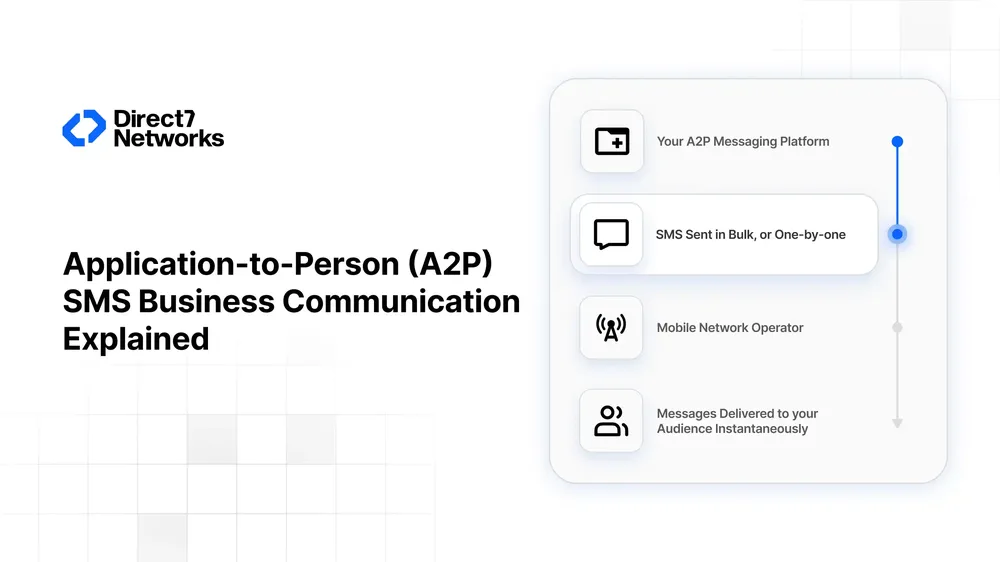
A2P SMS involves several interconnected components that work together to deliver business messages reliably.
| Component | Responsibility | |
|---|---|---|
| Business Application | Initiates the message from a CRM, ERP, website, or application. | |
| SMS API | Receives the request and authenticates it. | |
| Messaging Platform | Validates, routes, and manages message delivery. | |
| Carrier Network | Transfers the SMS through mobile operator infrastructure. | |
| Mobile Operator | Delivers the message to the subscriber's device. | |
| Customer Device | Receives and displays the SMS. |
Types of A2P Messaging
A2P messaging includes several forms of communication between systems or applications and individual recipients. Some of the most common types are:
Notifications
Keeping users informed about significant updates, events, or activities tied to their accounts, transactions, or subscriptions.
Promotional Campaigns
Distributing marketing communications, advertisements, exclusive offers, or discounts to attract customers and boost sales or conversions.
Authentication Messages
Enhancing security by verifying users’ identities or authorizing transactions through one-time passwords (OTPs), verification codes, or authentication links.
Alerts and Reminders
Providing timely notifications, reminders, or alerts about appointments, deadlines, emergencies, or service interruptions.
Transactional Messages
Sending updates related to services, such as order confirmations, delivery status updates, payment reminders, or account statements.
Benefits of A2P SMS for Businesses
If you are considering A2P messaging as the suitable communication channel for your enterprise, it is vital to understand its unique benefits. Below are the key reasons why A2P SMS remains a crucial resource:
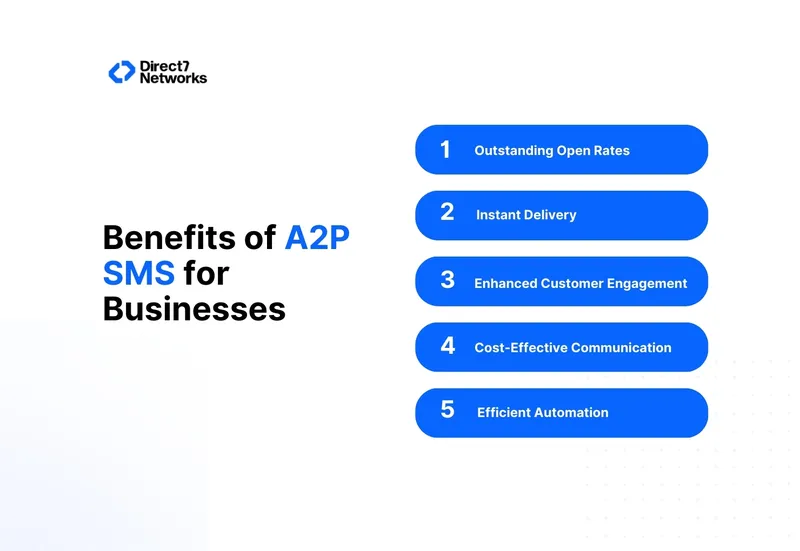
Outstanding Open Rates:
SMS consistently surpasses various other communication methods, like email, regarding open rates. This indicates that your messages are much more likely to be noticed and acted upon, making A2P SMS a dependable means of attracting your audience’s attention.
Instant Delivery:
A2P messaging ensures that your messages reach your audience promptly. Whether you’re sending critical alerts, timely updates, or promotional content, the effectiveness of A2P SMS guarantees quick delivery and feedback.
Enhanced Customer Engagement:
A2P SMS enables personalized and interactive communication that fosters stronger customer connections. From two-factor authentication (2FA) messages for added security to real-time order updates, this direct approach creates a more engaging customer experience.
Cost-Effective Communication:
Compared to other marketing communications strategies, A2P SMS offers a cost-effective way to reach a broad audience without sacrificing performance. It is an ideal solution for businesses looking to increase their return on investment while controlling costs.
Efficient Automation:
A key advantage of A2PSMS is its ability to automate tasks. Tasks such as appointment reminders and delivery notifications can be executed smoothly. This saves time and resources while improving the overall customer experience.
How does A2PSMS work?
Unlike P2P (Person-to-Person) messaging, where a user sends a message to a personal device, A2P messages are generated by an application, system, or software.
These messages are then managed by A2P gateway providers, such as D7 Networks, who aggregate them and ensure they are delivered via short codes or long numbers.
When your customer’s phone buzzes, they’ll see your message and, with any luck, take the action you intended – making your A2P SMS campaign a success!
SMS Delivery Lifecycle
Every A2P SMS passes through multiple delivery stages before reaching the recipient.
| Status | Description | |
|---|---|---|
| Accepted | The messaging platform accepts the request. | |
| Queued | The message waits for routing. | |
| Routed | The platform selects the appropriate carrier route. | |
| Sent to Carrier | The carrier receives the message. | |
| Delivered | The handset or carrier confirms successful delivery. | |
| Failed | Permanent delivery failure occurred. | |
| Expired | Delivery could not be completed within the allowed time. |
Monitoring these lifecycle states helps businesses identify delivery issues, optimize routing, and improve customer communication reliability.
Planning an Enterprise A2P Messaging Strategy
Before deploying A2P SMS, businesses should define how messaging supports operational workflows and customer communication.
Which business communications should use SMS?
Use SMS for time-sensitive notifications such as OTPs, payment confirmations, delivery updates, and appointment reminders. Avoid using SMS for lengthy or information-heavy conversations.
Which notifications require guaranteed delivery?
Security codes, fraud alerts, and critical account notifications require the highest delivery reliability and should use transactional messaging routes.
Which customer journeys should combine SMS with other channels?
Combine SMS with WhatsApp, email, or push notifications to create an omnichannel customer experience while reserving SMS for urgent communications.
Which business systems should trigger SMS?
CRM, ERP, payment platforms, logistics systems, booking software, and authentication services commonly generate automated A2P SMS.
Which messages require delivery reporting?
Business-critical messages should always track delivery status to monitor success rates and trigger fallback communication when necessary.
Which workflows require compliance monitoring?
Marketing campaigns, promotional messages, and international messaging should follow local telecom regulations, consent requirements, and sender ID policies.
Choosing the Right Communication Channel
Not every customer interaction requires the same communication channel.
| Use Case | Best Channel | |
|---|---|---|
| OTP Verification | SMS | |
| Payment Alerts | SMS | |
| Delivery Updates | SMS | |
| Marketing Campaigns | SMS + Email | |
| Customer Support | ||
| Appointment Reminders | SMS | |
| Product Recommendations | Email + WhatsApp |
SMS remains the preferred channel for urgent and time-sensitive communications because it does not require internet connectivity and achieves consistently high engagement rates.
What are some use cases of A2P SMS?
You might have encountered various instances of A2P SMS without even being aware of it. To refresh your memory, here are some common examples:
Marketing messages and promotions: If your company offers products or services, this is an especially beneficial application. Sending an A2P SMS enables you to notify your entire customer base about exclusive offers or discounts in just minutes, helping to enhance sales and reservations effectively.
Two-Factor Authentication (2FA): Have you ever received a code sent to your phone when trying to access a website or app? That is an example of 2FA in action. It serves as an effective method of protecting sensitive transactions. Protect user accounts and maintain privacy—all of this helps build customer trust.
Appointment Booking Reminders: For businesses that rely on scheduled appointment bookings, A2P SMS can be a game changer. Automated reminder messages for appointments help reduce no-shows. Increase customer satisfaction And reduce reliance on employees such as receptionists or booking agents.
Ordering and Shipping Information: There is nothing more frustrating than missing a package delivery due to poor communication. Automatic A2P SMS notifications update customers about their orders. This makes for a smoother, more trouble-free experience.
Emergency Alerts and Updates: When it comes to sharing urgent information quickly, A2P SMS is second to none. Timely notification of service interruptions or safety concerns or health-related information not only helps ensure customer safety, but also helps to protect customers. But it also reflects your commitment to their well-being.
How is A2P SMS different from P2P SMS?
The main difference between SMS A2P (application to person) and P2P (person to person) lies in the following areas.
Purpose:
A2P SMS is intended for business, transactional, or marketing use, while P2PSMS focuses primarily on personal interactions.
Sender:
A2PS SMS is generated by a business or organization, while P2PS SMS is sent by an individual user.
Delivery:
A2PS SMS is processed by the server before it reaches the recipient, while P2PS SMS is sent directly between mobile devices.
Cost:
In general, the cost of A2PSMS is higher compared to P2PSMS.
Reliability:
A2PS MS tends to be more reliable. Because it is less likely to be flagged or blocked by the carrier.
Delivery Time:
Delivery times for A2P SMS may be slightly longer due to the additional server processing.
Delivery Channels:
A2P SMS can be sent in bulk across various platforms like SMS, email, mobile applications, and chatbots. In contrast, P2P messages are mostly delivered through SMS, instant messaging applications, or social media platforms.
Sender Identification:
A2P messages are often associated with a dedicated sender ID representing the organization, whereas P2P SMS is sent using an individual's phone number or username.
A2P SMS And P2P SMS: Comparison
| Factor | A2P SMS (Application-to-Person) | P2P SMS (Person-to-Person) |
|---|---|---|
| Purpose | Business, transactional, or marketing use | Personal interactions |
| Sender | Generated by a business or organization | Sent by an individual user |
| Delivery | Processed by a server before reaching recipient | Sent directly between mobile devices |
| Cost | Generally higher | Typically lower |
| Reliability | More reliable, less likely to be flagged or blocked | Dependent on network and personal settings |
| Delivery Time | Slightly longer due to server processing | Faster, direct device-to-device |
| Delivery Channels | SMS, email, mobile apps, chatbots | SMS, instant messaging apps, social media |
| Sender Identification | Dedicated sender ID representing the organization | Individual’s phone number or username |
A2P SMS Compliance and Deliverability
Reliable message delivery depends on more than infrastructure. Businesses must also comply with local telecom regulations and carrier policies.
Important considerations include:
- Register Sender IDs where required.
- Obtain customer consent before sending promotional messages.
- Honor opt-out requests immediately.
- Separate promotional and transactional traffic.
- Follow country-specific messaging regulations.
- Avoid prohibited or misleading message content.
Strong compliance practices improve delivery rates, reduce carrier filtering, and protect customer trust.
Choosing the Right A2P Messaging Platform
Selecting the right A2P messaging platform is a critical step to ensure your business reaps the benefits of this communication channel. Here's how to approach the decision-making process:
Scalability and Reliability
Look for a platform that can handle your current messaging needs while scaling to support growth. Reliability is equally important; choose providers with a proven track record of high delivery rates and low latency.
Feature Set
Ensure the platform offers the features you need, such as automation, two-way messaging, and integration with existing systems. Advanced analytics and reporting tools can provide valuable insights to optimize your campaigns.
Global Reach and Compliance
If your company operates business on a global scale, choose a provider that boasts a robust international network. Make certain to adhere to regulations like GDPR, TCPA, or regional telecommunications laws to prevent any legal issues.
Ease of Integration
A good platform should offer simple integration through APIs. Compatibility with CRM software, marketing platforms, and other business tools can significantly streamline your operations.
Security
Security is essential, especially for transactional and authentication use cases. Verify that the platform offers encryption, secure APIs, and other safeguards to protect customer data.
Cost-effectiveness
Evaluate various pricing structures and determine the overall value. Look into platforms like D7 Networks, recognized for offering cost-effective yet powerful A2P messaging solutions that deliver a high return on investment without sacrificing quality.
Additional Enterprise Evaluation Criteria
When evaluating messaging platforms, also consider:
- API quality and documentation
- Delivery reports and webhook support
- Regional carrier connectivity
- Scalability for growing message volumes
- Platform redundancy and failover capabilities
- Analytics and reporting
- Security certifications
- Technical support responsiveness
A platform should provide operational visibility in addition to message delivery.
Contact us for a custom A2P messaging plan
Common A2P SMS Implementation Mistakes
Organizations often encounter avoidable issues when deploying enterprise messaging.
Ignoring Sender ID Registration
Some countries require approved sender IDs before commercial messaging begins.
Using Promotional Routes for Transactional Messages
Critical notifications should always use high-priority transactional routes.
Not Monitoring Delivery Reports
Delivery reports help identify routing issues and improve operational visibility.
Poor Consent Management
Maintain accurate opt-in and opt-out records to remain compliant.
Ignoring Regional Regulations
Telecom regulations differ across countries and should be reviewed before launching campaigns.
Enterprise Messaging with D7 Networks
Enterprise Messaging Infrastructure
D7 Networks provides APIs that enable businesses to integrate SMS into applications, CRM platforms, ERP systems, authentication services, and customer engagement workflows.
Delivery Visibility
Delivery reports, webhook notifications, and analytics help businesses monitor messaging performance and investigate delivery issues.
Global Messaging Coverage
International carrier connectivity supports business messaging across multiple countries while simplifying integration through a single API.
Conclusion
A2P SMS has become one of the most dependable communication channels for enterprise messaging, supporting everything from authentication and transaction alerts to customer engagement and operational notifications.
Successful A2P messaging depends on more than sending text messages. Carrier connectivity, regulatory compliance, delivery visibility, and reliable APIs all contribute to consistent message delivery and customer trust.
As organizations expand their communication strategies, choosing a platform with strong infrastructure, operational analytics, and scalable integration capabilities becomes just as important as message reach itself.