
WhatsApp or SMS? How Businesses Can Use Both
WhatsApp or SMS for business? Learn when each channel fits, how fallback works, and how to build a practical multi-channel messaging strategy.
When a business needs to send a customer an order update, appointment reminder, authentication code or urgent alert, the obvious question is often: WhatsApp or SMS?
But that question is slightly too narrow.
The better question is: Which channel fits this message, this customer and this situation, and what should happen if the preferred channel cannot deliver it?
WhatsApp and SMS overlap, but they are not interchangeable transports. They have different requirements, message formats, platform rules and customer experiences. A business may use either one, or deliberately use both as part of the same notification architecture.
The important part is not choosing a permanent winner. It is designing the communication flow around the business event.
What is the real difference between WhatsApp and SMS for business messaging?
At a basic level, SMS is a carrier-based messaging channel, while WhatsApp business messaging operates through the WhatsApp Business Platform and its associated rules and infrastructure.
That difference affects the entire workflow.
SMS is fundamentally designed around a mobile number and the mobile network. Its strength is simplicity: the customer does not need a separate messaging application to receive an SMS.
WhatsApp requires the customer to be reachable on WhatsApp, while business messaging is governed by WhatsApp’s policies and platform requirements. WhatsApp also supports richer formats such as media, locations, interactive messages, and templates. Meta’s current Business Platform documentation describes both customer-initiated conversations and business-initiated messages using customizable templates.
So the comparison is not simply:
SMS = basic
WhatsApp = advanced
It is closer to:
SMS = a broadly available mobile messaging transport
WhatsApp = a richer, platform-governed conversational channel
That distinction becomes important when designing notifications.
| Dimension | SMS | |
|---|---|---|
| Customer requirement | A reachable mobile number and SMS service | Customer must be reachable through WhatsApp |
| Message format | Primarily text | Text, media and interactive formats where supported |
| Interaction | Possible, depending on the SMS setup and market | Designed for two-way conversational interaction |
| Business messaging rules | Vary by country, carrier and sender type | WhatsApp Business policies and platform requirements apply |
| Business-initiated messaging | Subject to applicable SMS rules | Approved templates are required outside the customer service window |
| Delivery information | Depends on network/provider capabilities | Platform status events can report states such as sent, delivered, read and failed |
| Cost | Varies by country, carrier, route and provider | Varies according to current WhatsApp pricing rules, category and recipient market |
| Typical strength | Simple, broad-reach notifications | Richer, interactive or conversational communication |
That distinction becomes important when designing notifications.The table is a starting point, not a decision rule. The actual answer depends on the notification and customer.
When does WhatsApp add something SMS cannot?
Consider an appointment reminder.
An SMS might say:
“Your appointment is tomorrow at 10:30 AM. Reply or call to reschedule.”
On WhatsApp, the same business event could potentially be represented using richer content, such as location information or supported interactive elements.
That difference can matter when the customer needs to do something, rather than simply receive information.
WhatsApp’s Business Platform supports media and interactive messages, including list messages and reply buttons.
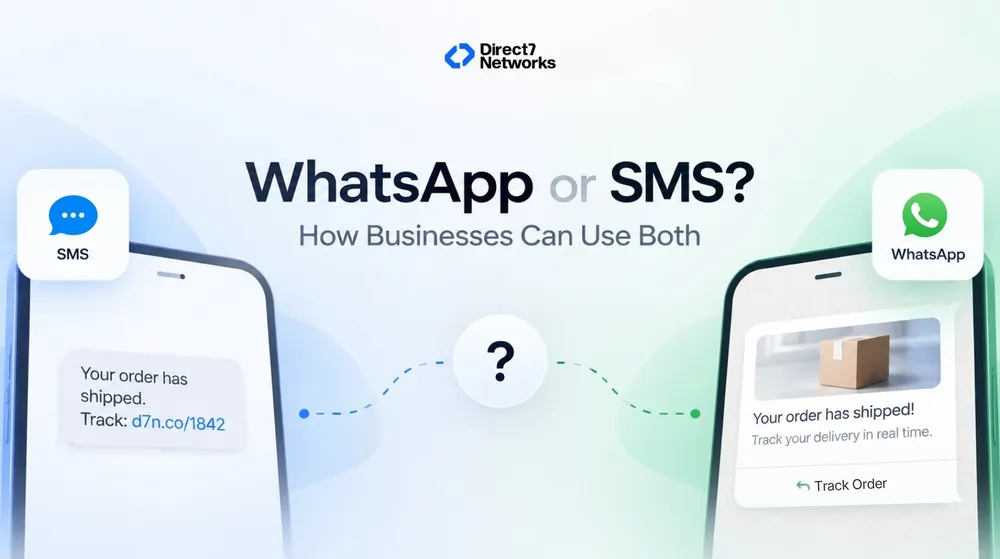
The same principle applies to an order update. A short SMS may be entirely adequate for:
“Order #1842 has shipped. Track: example.com/1842”
But if the customer needs a richer status experience, additional information or an interaction, WhatsApp may provide a more suitable representation.
This is why WhatsApp should not be treated as “SMS with more features.” Moving the same notification from one channel to another can change the message design, interaction model, eligibility requirements and operational workflow.
There is another important constraint: WhatsApp business messaging is permission- and policy-driven. Meta’s current Business Messaging Policy says businesses may contact people on WhatsApp when they have the person’s mobile number or username and have received opt-in permission, while businesses must respect opt-out requests.
Business-initiated conversations also have template requirements outside the 24-hour customer service window.
When does SMS still make more sense?
Sometimes the notification does not need richer interaction.
Imagine an urgent service alert:
“Scheduled maintenance begins at 11 PM. Service may be unavailable for up to 30 minutes.”
If the essential requirement is to communicate a short piece of information to customers through a mobile-number-based channel, the additional capabilities of WhatsApp may not add much value.
SMS can also be important when a customer is not reachable through WhatsApp.
That makes customer availability one of the first questions in a channel decision.
But availability is only the beginning.
Availability → Eligibility → Delivery
A useful way to design business messaging is to separate three questions that are often mixed together.
1. Availability
Can this customer potentially be reached through the channel?
For SMS, that may mean having a valid, usable mobile number and an appropriate route.
For WhatsApp, it means the customer is reachable through WhatsApp and the business can legitimately message them under the applicable requirements.
2. Eligibility
Even if the customer is reachable, can this particular message be sent through that channel?
For WhatsApp, this can involve opt-in, templates, the customer service window, message type and platform policies. Meta’s current policy states that business-initiated conversations outside the 24-hour customer service window require approved message templates.
SMS has its own considerations, which can vary significantly by country, sender type, carrier and use case. In India, for example, TRAI’s commercial-communication framework includes requirements around registered senders, headers and content templates.
3. Delivery
What happened after the message was actually attempted?
This is a separate question from whether the message could be sent.
WhatsApp’s platform exposes message status information through webhooks, including statuses such as sent, delivered, read and failed.
The distinction matters because:
Unavailable ≠ ineligible ≠ undelivered.
A business that treats all three as simply “WhatsApp failed” loses useful information for deciding what should happen next.
What changes when a business uses both?
Using WhatsApp and SMS does not necessarily mean sending every notification through both.
A better model is:
Business event
↓
Choose preferred channel
↓
Check availability and eligibility
↓
Send channel-specific message
↓
Process delivery status
↓
Apply defined fallback logic if appropriate
Consider an order-confirmation event.
The event is:
Order confirmed.
The system should not care whether the customer ultimately receives that confirmation through WhatsApp or SMS.
The channel decision is a separate layer.
That separation makes the architecture easier to maintain. The same business event can produce different representations:
WhatsApp:
“Your order is confirmed” + product information + supported interactive elements.
SMS:
“Order #1842 confirmed. Track: example.com/1842”
One event. Two possible message representations.
That is more useful than treating WhatsApp and SMS as two completely separate notification systems.
What should happen when the preferred channel fails?
This is where the phrase “WhatsApp SMS fallback” can become misleading.
There is no universal rule that says:
WhatsApp failed → automatically send SMS.
Fallback is an application-level decision.
Suppose a business prefers WhatsApp for an order notification. The WhatsApp attempt fails.
Before sending SMS, the system may need to determine:
- Is the customer eligible for SMS?
- Is there a valid mobile number?
- Is this type of notification permitted through SMS in the relevant market?
- What caused the WhatsApp failure?
- Has another notification already been delivered?
- Is this failure temporary or final?
- Would sending SMS create a duplicate?
- Is SMS actually configured as a fallback for this notification?
The right fallback condition therefore needs to be defined by the business.
For example:
Order confirmed → WhatsApp preferred → delivery condition not satisfied → SMS eligible → send SMS
That is very different from blindly sending two messages whenever one channel reports an error.
Why sending everything through both channels can be a mistake
Multi-channel messaging does not mean:
Send everywhere.
If a customer receives the same appointment reminder through WhatsApp and SMS at almost the same time, the business has paid for two delivery attempts and potentially created an unnecessary customer interaction.
It can also make reporting harder.
If a customer clicks the WhatsApp link after receiving the SMS, which channel should receive credit? If both messages arrive, which one represents the successful notification?
A mature system therefore needs rules for:
- primary channel
- alternative channel
- eligibility
- fallback conditions
- duplicate prevention
- delivery attribution
- status recording
The goal is not maximum message volume.
The goal is successful communication with the appropriate amount of communication.
How should WhatsApp and SMS fit into one notification architecture?
A clean architecture separates five things:
1. Business event
Something happens in the business system.
Payment completed.
2. Channel decision
The notification service determines which channel should be used.
WhatsApp preferred.
3. Message construction
The system creates the representation appropriate to that channel.
WhatsApp template with supported components.
4. Delivery
The selected messaging infrastructure attempts to deliver it.
5. Status processing
The system receives and records the result.
Delivered.
Or, if the defined fallback condition is met:
WhatsApp → SMS
This architecture is useful because the payment system does not need separate business logic for every messaging channel.
The event remains:
Payment completed.
The messaging layer decides how that event should reach the customer.
The practical decision is notification-specific
There is no universal WhatsApp-versus-SMS answer.
For an order confirmation, either may work. WhatsApp becomes more useful when richer information or interaction adds value.
For an appointment reminder, WhatsApp can be useful when the customer may need location information, confirmation or interaction. SMS may be sufficient when the reminder only needs to communicate time and date.
For authentication, the business should evaluate the currently supported authentication mechanisms, customer eligibility, urgency and the relevant market rather than assuming that one channel should always be primary.
For an urgent service alert, simplicity and reach may matter more than rich interaction.
The right question is therefore not:
“Which channel is better?”
It is:
“What does this notification need to accomplish?”
Where D7 fits
Once the business has decided that it needs SMS, WhatsApp, or both, the next problem is implementation.
D7 Networks provides APIs for both sides of this architecture.
Its SMS Messaging API provides a REST-based interface for sending and receiving SMS, while its SMS documentation also exposes message-status reporting.
D7’s WhatsApp Messaging API supports sending and receiving WhatsApp messages, delivery callbacks and status checks. Its documentation describes delivery events including queued, sent, delivered, read and dropped, as well as user-initiated events.
The WhatsApp API supports text, media, location and interactive message types, while D7’s documentation also covers templates and authentication messages.
For a business implementing the architecture described above, that distinction is useful: the business event can remain in its own application while the messaging layer connects the event to the selected channel and processes delivery information.
D7 also publishes separate documentation for its SMS API and WhatsApp API, giving development teams channel-specific integration paths rather than requiring them to treat the two channels as identical transports.
D7’s current pricing page also lists both SMS and WhatsApp services, although messaging costs should be checked against the current destination, provider and platform pricing applicable when an implementation is planned.
The takeaway
WhatsApp and SMS are not two versions of the same messaging channel.
They solve overlapping problems under different conditions.
SMS can be valuable when the requirement is straightforward mobile messaging and broad reach through the SMS ecosystem. WhatsApp becomes particularly useful when the customer is reachable there and the notification benefits from richer content, interaction or a conversational experience.
For some businesses, one channel may be enough.
For others, both belong in the same system, but not necessarily for the same notification.
The strongest architecture starts with the business event, then determines:
Which customer? Which channel is available? Is the message eligible? What message representation fits? What happened after delivery was attempted? And, if it fails, is there a defined reason to use another channel?
That is the difference between simply sending messages and designing a messaging system.