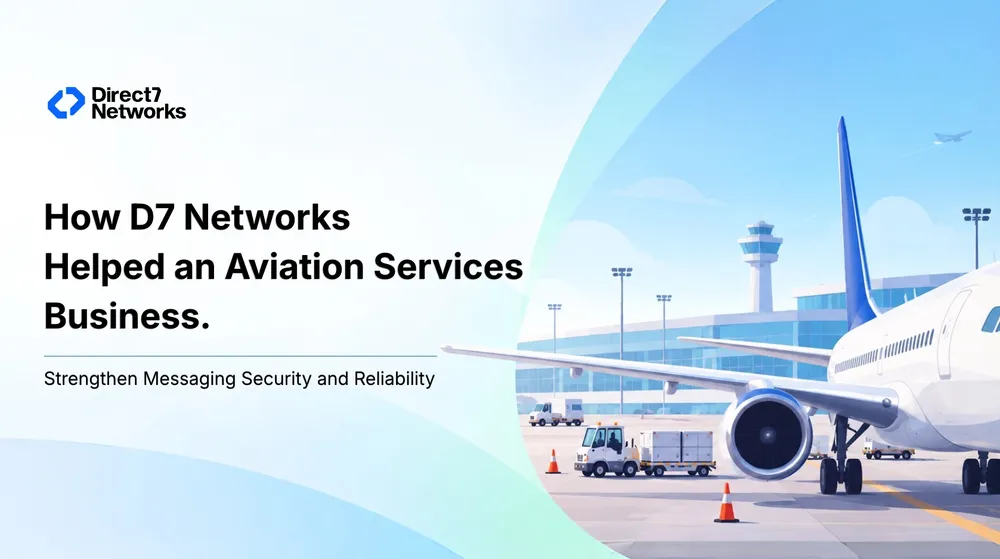

How D7 Networks Helped an Aviation Services Business Strengthen Messaging Security and Reliability
Explore how an aviation services business improved messaging security through SMS API integration, OTP verification, two-factor authentication and IP whitelisting.
In the aviation industry, timely and secure communication is essential to delivering an easy customer experience. From flight check-in confirmations and baggage updates to one-time passwords (OTPs) for authentication, businesses rely on messaging systems to keep passengers informed and protect their digital services.
An aviation services business offering convenient airport alternatives, including home check-in, baggage delivery, and city check-in, needed a reliable messaging solution for SMS, OTP, and transactional communications.
For one aviation-services business in Abu Dhabi, choosing a new messaging provider was not simply an API decision.The company had previously experienced a spam attack with its former provider. That experience made security a major consideration when selecting a new messaging partner.
The challenge was no longer just finding a service that could send SMS and OTPs. It was establishing greater control over the messaging account and examining how the application requesting those messages interacted with the messaging infrastructure.
D7 Networks helped the business strengthen its messaging security, configure essential safeguards, and establish a more secure foundation for its communication workflows.
The Challenge: Security Concerns After a Messaging Attack
The business had experienced a spam attack while using its previous messaging provider. This raised concerns about the security of its messaging account and the potential misuse of its messaging infrastructure.As the business relied on SMS for transactional notifications and OTPs for authentication, protecting its messaging environment was a priority.
Before selecting a new provider, the business needed a solution that could address several key concerns:
- Account security: Prevent unauthorized access and reduce the risk of account misuse.
- API protection: Review how messaging APIs were integrated and protected.
- Sender ID registration: Obtain guidance and support throughout the sender ID registration process.
- Reliable messaging: Support SMS, OTP, and transactional communication requirements.
- Technical guidance: Receive expert assistance with testing, security configurations, and implementation.
The business needed more than a messaging API. It needed a partner that understood the importance of security in customer-facing aviation services.
The Solution: How D7 Networks Addressed the Challenges
We supported the business throughout the onboarding, testing, and security configuration process, with a particular focus on protecting its messaging account and API integrations.
1. Strengthening Account Security With Two-Factor Authentication
D7 Networks helped the business secure its account by implementing two-factor authentication (2FA). This added an extra layer of protection beyond standard login credentials, helping reduce the risk of unauthorized account access.
For businesses that depend on messaging APIs for authentication and transactional notifications, securing the provider account is an important part of protecting the overall communication workflow.
2. Implementing IP Whitelisting
To strengthen access control, D7 Networks helped configure IP whitelisting for the account.
IP whitelisting restricts access to specified, approved IP addresses, helping reduce the risk of unauthorized access from unrecognized locations or systems. Combined with 2FA, this provided an additional layer of protection for the business's messaging environment.
These security measures helped address the business's primary concern following its previous experience with a spam attack.
3. Supporting Sender ID Registration
Sender ID registration is an important step for businesses sending branded SMS messages, subject to the requirements of the destination country and messaging route.
D7 Networks guided the business through the sender ID registration process, explaining the necessary steps and providing support throughout the process.
This helped the business navigate the registration requirements and prepare its messaging setup for its intended communication use cases.
4. Enabling Sandbox Testing Before Deployment
Before moving messaging workflows into production, D7 Networks supported sandbox testing to help validate the integration and message-sending process.
Testing allowed the business to examine its implementation in a controlled environment, identify potential issues, and prepare its messaging workflows before deployment.
This step was particularly important for OTP and transactional messages, where dependable communication is essential to the customer experience.
5. Reviewing Website and API Security
Beyond account configuration, D7 Networks' IT experts reviewed the business's website and messaging integration to understand how OTP requests were triggered and how the APIs were protected.
The technical review focused on understanding the OTP triggering process and examining API protection measures. This helped identify areas requiring attention and provided the business with guidance on securing its messaging integration.
By looking beyond the messaging dashboard, D7 Networks helped the business consider security across both its provider account and its website-based communication workflows.
6. Providing Step-by-Step Technical Guidance
Security implementation often requires coordination across account settings, website integrations, API configurations, and registration procedures.
D7 Networks provided guidance throughout these steps, helping the business understand the required configurations and address its concerns during onboarding.
This hands-on support gave the business a clearer path toward establishing a more secure messaging environment.
How D7 APIs Support Aviation Operations
The business's services focused on making air travel more convenient by allowing passengers to complete selected airport procedures away from the airport. SMS and OTP messaging can support these experiences by keeping passengers informed and enabling secure interactions.
Home Check-in
Passengers can check in for their flights, complete baggage procedures, and collect their boarding cards from the comfort of their homes.
How messaging helps: Transactional SMS can communicate check-in confirmations, service updates, and important reminders. OTPs can support authentication where required by the service workflow.
Land & Leave
Passengers can avoid waiting at the airport to collect their baggage, with baggage delivered directly to their doorstep.
How messaging helps: SMS notifications can provide baggage service confirmations, delivery updates, and other relevant transactional information, helping passengers stay informed throughout the process.
City Check-in
Passengers can skip airport check-in queues by dropping off their baggage and obtaining their boarding passes at a convenient location.
How messaging helps: Transactional messages can confirm bookings, communicate check-in details, and provide service-related updates. OTP verification can support secure access to relevant digital services.
Across these use cases, messaging is not simply a notification channel. It can be an important part of delivering a convenient, connected, and secure passenger experience.
The Outcome: A More Security-Conscious Messaging Setup
Through its technical and onboarding support, D7 Networks helped the business address its key security concerns and establish important safeguards for its messaging operations.
Key areas of support included:
- Enhanced account protection through 2FA and IP whitelisting.
- Guided sender ID registration to help navigate the relevant registration process.
- Pre-deployment testing support through sandbox testing.
- Technical security guidance based on a review of the website's OTP workflow and API protection.
- Support for business-critical messaging across SMS, OTP, and transactional communication requirements.
These measures helped the business take a more structured approach to messaging security after its previous experience. While security controls reduce risks, ongoing monitoring, secure API key management, and appropriate website-side protections remain important for maintaining a secure environment.
Why Businesses Choose D7 Networks for Messaging APIs
For businesses in aviation and other service-driven industries, choosing a messaging provider involves more than comparing API features or message prices. It also means considering account security, technical expertise, onboarding support, and the ability to support critical communication workflows.
D7 Networks provides SMS APIs and OTP verification capabilities to help businesses automate customer communications and authentication processes. Its technical support helps businesses navigate integration, testing, and security configuration requirements.
By combining messaging capabilities with practical implementation guidance, D7 Networks helps businesses build communication workflows that are designed around their operational needs.
Conclusion
A security incident can prompt a business to reassess not only its messaging provider but also the way it protects its communication infrastructure.
In this case, D7 Networks supported an aviation services business with SMS, OTP, and transactional messaging requirements by helping strengthen account security, configure IP whitelisting and 2FA, navigate sender ID registration, conduct sandbox testing, and review website-based OTP and API protection workflows.
The experience highlights an important principle for businesses that rely on messaging APIs: reliable communication starts with a secure foundation.
With the right messaging infrastructure and technical guidance, businesses can work toward protecting their communication systems while delivering timely, convenient experiences to their customers.
Looking for a secure messaging solution for your business? Explore D7 Networks' SMS API and OTP Verification API to support your transactional messaging and authentication needs.