
How to Send WhatsApp Messages in Bulk : A Complete Guide
Reaching thousands of customers instantly is easier than ever—but sending bulk WhatsApp messages successfully requires much more than clicking send.
Businesses today use WhatsApp for marketing campaigns, order updates, appointment reminders, customer support, and transactional notifications. However, successful bulk messaging depends on more than scale. Customer consent, approved message templates, personalization, and compliance with Meta's Business Messaging Policies all influence delivery, engagement, and long-term account quality.
This guide explains how to send bulk WhatsApp messages using the WhatsApp Business Platform, choose the right messaging approach, improve campaign performance, and avoid common mistakes that reduce engagement or trigger account restrictions.
What Are Bulk Broadcast WhatsApp Messages?
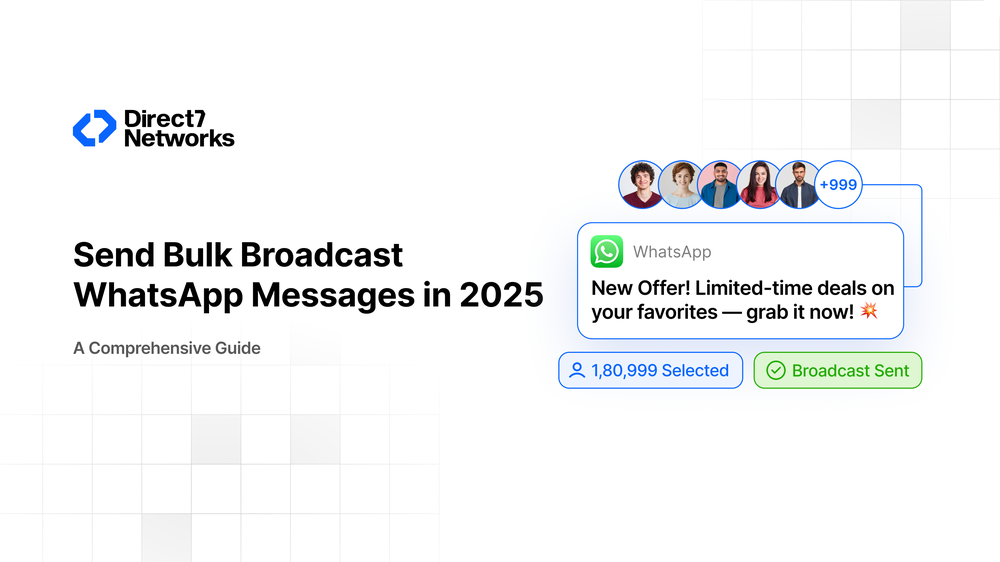
Bulk Broadcast WhatsApp message allows you to send the same message to several recipients simultaneously. This feature is especially useful for businesses looking to send promotional proposals, event reminders, or important updates to their customers. Unlike group messages, broadcast messages are sent individually to each recipient, ensuring privacy and a personal touch.
WhatsApp Broadcast Lists vs WhatsApp Business API
Many businesses assume WhatsApp Broadcast Lists and the WhatsApp Business API offer the same capabilities. In reality, they serve different purposes and are designed for different business sizes.
| Feature | Broadcast List | WhatsApp Business API |
|---|---|---|
| Maximum Scale | Small contact lists | Enterprise-scale messaging |
| Personalization | Limited | Dynamic personalization |
| Automation | No | Yes |
| CRM Integration | No | Yes |
| Approved Templates | No | Yes |
| Analytics | Limited | Advanced reporting |
| Multi-Agent Support | No | Yes |
| Best For | Small businesses | Medium and large businesses |
Broadcast Lists work well for small businesses communicating with existing contacts. The WhatsApp Business API is designed for organizations that require automation, CRM integration, analytics, and scalable customer communication.
Why Use Bulk WhatsApp Messages in 2025?
- Wide Reach: The huge user base of WhatsApp makes it an ideal platform to reach a larger audience.
- High engagement: WhatsApp messages have an open rate of more than 98%, which is one of the most effective communication channels.
- Cost-effective: WhatsApp bulk messaging is cheaper than traditional SMS or email marketing and provides better ROIs.
- Personalization: With advanced equipment, you can personalize messages to make them more relevant to each recipient.
- Compliance: WhatsApp update policies in 2025 ensure that businesses can send wholesale messages after privacy and spam rules.
Is Bulk WhatsApp Messaging Right for Your Business?
Before investing in WhatsApp automation, evaluate whether it matches your communication requirements.
How many customers do you contact each month?
Businesses sending hundreds or thousands of messages benefit more from API-based automation than manual messaging.
Do you need automated communication?
If messages are triggered by customer actions, appointments, or purchases, automation significantly improves efficiency.
Do you require CRM integration?
Connecting WhatsApp with your CRM allows personalized communication based on customer data and interaction history.
Are your messages promotional or transactional?
Different message categories have different approval requirements and conversation rules.
Do you operate across multiple countries?
International messaging requires consideration of language, customer preferences, and regional compliance.
Will multiple team members manage conversations?
Businesses with customer support teams often require shared inboxes and multi-agent capabilities available through the API.
How to Send Bulk WhatsApp Messages in 2026
Step 1: Choose the Right WhatsApp API Provider
To send bulk messages effectively, businesses should use an official WhatsApp Business API provider like Direct7 Networks, ensuring compliance with WhatsApp's policies.
Select an official WhatsApp Business Solution Provider that offers reliable onboarding, technical support, analytics, and integration options. Verify that the provider follows Meta's Business Messaging Policies.
Step 2: Register for a WhatsApp Business API Account
Registering for the WhatsApp Business API requires approval from WhatsApp. This process involves:
- Verifying your business account
- Setting up a display name
- Connecting a phone number
Prepare your Meta Business account before applying. Business verification, an approved display name, and accurate company information help streamline onboarding.
Step 3: Import Contacts
Prepare a contact list by collecting customer numbers with proper consent to comply with WhatsApp policies.
Only import contacts who have explicitly agreed to receive WhatsApp communications. Consent can be collected through website forms, checkout pages, QR codes, or Click-to-WhatsApp advertisements.
Step 4: Create Engaging Message Templates
WhatsApp requires pre-approved message templates for bulk messaging. Ensure your templates are:
- Clear and concise
- Personalized with customer details
- Engaging with multimedia content
Template approval depends on compliance with Meta's guidelines. Write clear, useful messages, avoid excessive promotional language, and include variables only where appropriate.
Step 5: Use an Official Bulk Messaging Tool
Bulk messaging should be conducted using approved platforms like D7 Networks, which provide:
- Automated scheduling
- Message tracking and analytics
- Chatbot integration for interactive messaging
Understand conversation categories and pricing before launching campaigns. Marketing, utility, authentication, and service conversations follow different rules and billing models.
Step 6: Monitor Performance and Optimize
Analyze message delivery rates, customer responses, and engagement metrics to refine future campaigns.
Monitor key metrics such as delivery rate, read rate, response rate, quality rating, conversation volume, and customer feedback. Continuous optimization improves long-term campaign performance.
Best Practices for Bulk WhatsApp Messaging
Obtain Customer Consent
Ensure compliance with WhatsApp policies by obtaining explicit opt-ins from recipients before sending bulk messages.
Personalize Messages
Using recipient names and relevant details enhances engagement and customer experience.
Maintain Message Quality
Avoid spam-like behavior by crafting valuable and relevant messages.
Leverage Automation
Chatbots and automation tools streamline bulk messaging, improving efficiency and response time.
Follow WhatsApp Guidelines
Adhere to WhatsApp's policies to prevent account suspension or message blocking.
Challenges and Solutions in 2026
Strict WhatsApp Policies
WhatsApp has tightened its policies to prevent spam. To avoid getting banned:
- Use only approved message templates.
- Ensure your messages provide value to recipients.
High Competition
With more businesses using WhatsApp for marketing, standing out can be challenging. Focus on creating highly personalized and engaging content.
Technical Issues
API integrations and third-party tools can sometimes be complex. Work with a reliable BSP and ensure your team is trained to handle technical aspects.
The Future of Bulk WhatsApp Messaging
As we move beyond 2025, we can expect further advancements in WhatsApp’s capabilities, such as:
- Enhanced AI-driven personalization.
- Integration with other platforms like Instagram and Facebook.
- Improved analytics and automation features.
How Different Industries Use Bulk WhatsApp Messaging
Ecommerce
Order confirmations, shipping updates, abandoned cart reminders, promotional campaigns.
Banking
Transaction alerts, OTP verification, account notifications, fraud alerts.
Healthcare
Appointment reminders, prescription updates, patient communication.
Logistics
Delivery tracking, driver updates, shipment notifications.
Education
Admission updates, class reminders, fee notifications.
Travel
Booking confirmations, itinerary changes, check-in reminders.
SaaS
User onboarding, subscription renewals, product announcements, support communication.
Conclusion
Successful bulk WhatsApp messaging is not measured by the number of messages sent but by the value those messages deliver. Businesses that prioritize customer consent, relevant communication, and thoughtful personalization consistently achieve stronger engagement than those relying on high-volume broadcasts.
As WhatsApp continues to evolve into a primary business communication channel, automation, approved templates, and compliance with Meta's policies become increasingly important. Regularly reviewing campaign performance, maintaining healthy quality ratings, and optimizing messaging strategies help businesses build sustainable customer relationships.
Organizations implementing the WhatsApp Business API can further strengthen their communication by integrating CRM systems, automating workflows, and monitoring campaign performance. Providers such as D7 Networks support businesses through API onboarding, messaging automation, and ongoing optimization, enabling scalable customer communication while following Meta's best practices.