
WhatsApp for Insurance Agents: The Practical Guide to Selling, Servicing, and Retaining Clients
How insurance agents use WhatsApp for leads, renewals, claims, and cross-selling, with real message templates and workflows.
Daniel bought a health insurance policy fourteen months ago. Last week, his wife was hospitalised. He called the claims line busy. He sent an email,auto-replied. He tried WhatsApp on the agent's personal number, but there was no response for six hours. By the time someone finally picked up, Daniel had already decided to switch providers at renewal.
He didn't leave because the policy was bad. He left because no one was there when it mattered. That gap between what insurance promises and how it actually communicates is where most customer relationships break down, and it's the exact problem WhatsApp, used properly, is built to close.
Why WhatsApp Works So Well for Insurance Conversations
Insurance products are rarely impulse purchases. Customers ask questions, compare plans, share concerns, and often take time before making a decision.
WhatsApp supports that kind of gradual conversation naturally.
An agent can explain policy terms through voice notes, send premium breakdowns as PDFs, answer follow-up questions quickly, and continue the conversation over days or weeks without forcing the customer into a formal sales process.
This matters because insurance buyers often feel overwhelmed by:
- Technical policy language
- Too many plan choices
- Unclear claim procedures
- Lack of trust
- Delayed responses from agents
Good insurance customer communication reduces friction at each stage. WhatsApp makes that easier because the interaction feels more conversational than transactional.
Turning a Cold Lead into a Real Conversation
Consider how most insurance leads are handled today. A prospect fills a form online at 9pm. The agent sees it at 9am the next morning, sends a template email, and waits. By then, the prospect has already spoken to two other agents who responded faster.
WhatsApp collapses that window. When a prospect clicks a Facebook or Instagram ad for, say, term life insurance, a well-configured Click-to-WhatsApp ad opens a conversation instantly, no form, no redirect, no wait.
Here's what that first exchange can look like:
Agent (automated, within 30 seconds): "Hi! Thanks for your interest in term life cover. I'm Noor from Secure Life. Quick question, are you looking to cover just yourself, or your family too? That'll help me find the right plan. [ Just me ] [ Me + Family ]"
The prospect taps a button. No typing required. The conversation has begun. From there, a simple qualification flow age, income range, existing coverage, takes under two minutes and gives the agent everything needed to send a relevant quote. Insurance agents using this WhatsApp lead generation approach report up to 45% higher conversion rates compared to web forms and cold call follow-ups.
A Simple Lead Response Workflow
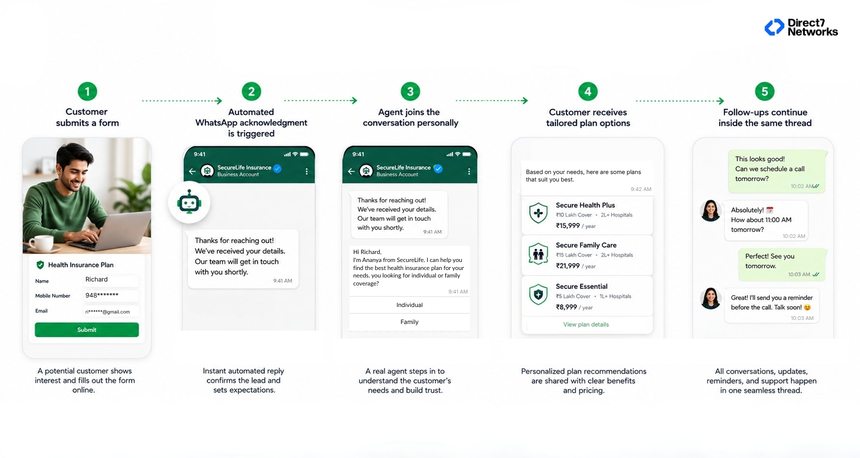
The important part is balance. Customers should feel assisted, not trapped inside automation.
A good first-response message often sounds like this:
“Hi Anna, thanks for your interest in health insurance. I’m Sara from ABC Insurance. I can help you compare plans based on your budget and coverage needs. Are you looking for individual or family coverage?”
Short. Clear. Human.
Note:
“Dear customer, thank you for choosing our premium insurance solutions.”
fference matters more than most teams realize.
Explaining Insurance Products Without Confusing Customers
One reason customers delay insurance purchases is simple, they do not fully understand what they are buying.
WhatsApp gives agents flexible ways to simplify explanations:
- Short text summaries
- Infographics
- Premium calculators
- Voice notes
- Video explainers
- Policy brochures
- Comparison charts
Instead of sending a 20-page PDF immediately, smart agents break information into smaller conversations.
For example:
The “3-Layer Explanation” Framework
Layer 1: Simple Benefit
“Covers hospitalization expenses up to ₹10 lakh.”
Layer 2: Real-Life Example
“If someone in your family needs surgery, most major expenses can be covered under the policy.”
Layer 3: Important Conditions
“There’s a 30-day waiting period except for accidents.”
This structure improves understanding without overwhelming the customer
Policy Education That Actually Sticks
Here's a common scenario: a customer buys a health policy, pays the premium, and assumes she's fully covered. Eighteen months later, she tries to claim for a pre-existing condition and discovers it wasn't covered for the first two years. She feels misled, even though the exclusion was on page 11 of the document she never read.
WhatsApp gives agents a practical way to close this gap right at the point of sale. Instead of sending a 48-page PDF and hoping for the best, an agent can send a plain-language explainer within minutes of policy confirmation:
"Hi Amira ! Your policy is now active 🎉 A few things worth knowing: ✅ Hospitalisation above ₹5,000/day, fully covered ⏳ Pre-existing conditions, covered after a 24-month waiting period ❌ Cosmetic procedures, not covered Want me to send a one-page summary you can save for later?"
Three bullet points. Read in 20 seconds. Amira now understands what she bought. That's the message that prevents the angry claim dispute 18 months from now.
Image carousels comparing two plan options, short explainer videos for complex products like ULIPs or critical illness riders, and voice notes addressing specific clauses, all of these work inside WhatsApp without the customer needing to navigate anywhere else.
Renewals: The Revenue Problem That's Already Solved
Most policy lapses aren't deliberate. Customers forget. They get busy. The renewal notice lands in the promotions folder, and three weeks later their coverage has quietly lapsed.
Insurance companies using proactive WhatsApp renewal sequences report 30–40% improvements in renewal rates. The four-message sequence below is the difference between a lapsed policy and a retained customer:
45 days out:
"Hi Emma, your motor policy expires on 15 June. Your current premium is ₹8,400. I'll send you renewal options next week, has anything changed with the vehicle this year?"
21 days out:
"Hi Emma! Here's your renewal summary: 📋 Policy: [Policy Name] | Expires: 15 June | Premium: ₹8,400 Tap below to renew in one step: [Renew Now 🔒] [Call Me]"
7 days out:
"Emma, one week left on your policy. Most customers renew in under 2 minutes. [Renew Now]"
1 day after lapse:
"Hi Emma, looks like your policy lapsed yesterday. No problem, we can reinstate it quickly. Want me to send the options? There's usually a short gap waiver available."
The tone of each message is different by design. The 45-day message is conversational and opens a dialogue. The 21-day message is clear and transactional. The 7-day message uses social proof. The lapse recovery message is non-judgmental and solution-focused. None of them feel like automated spam, because each is written for a specific moment in the customer journey, with the right intent, timing, and context behind it.
Claims Support: Being There When It Counts
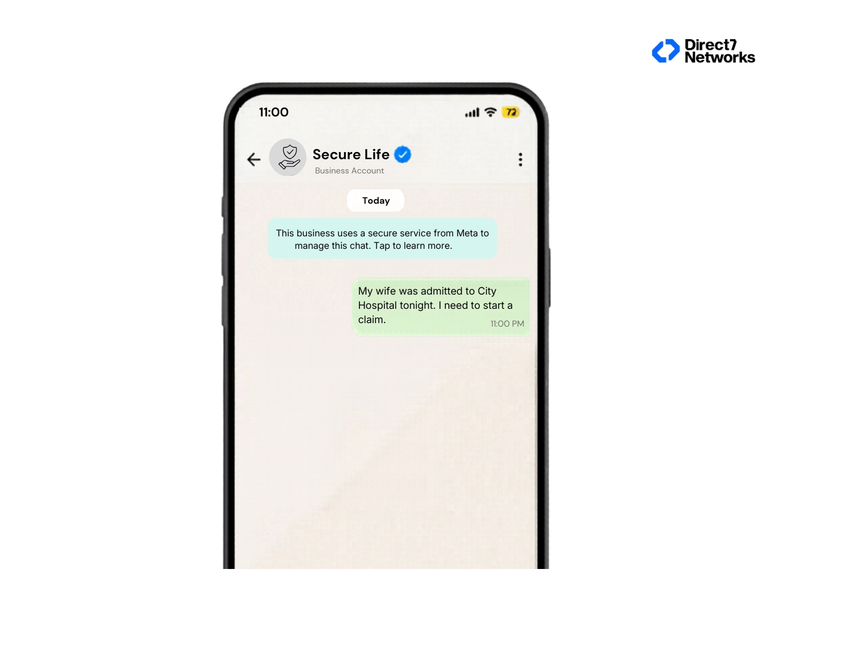
Go back to Daniel from the opening. If his insurer had a properly configured WhatsApp claims workflow, his experience would have looked like this instead:
Daniel messages the claims number at 11pm:
Automated reply (within seconds):
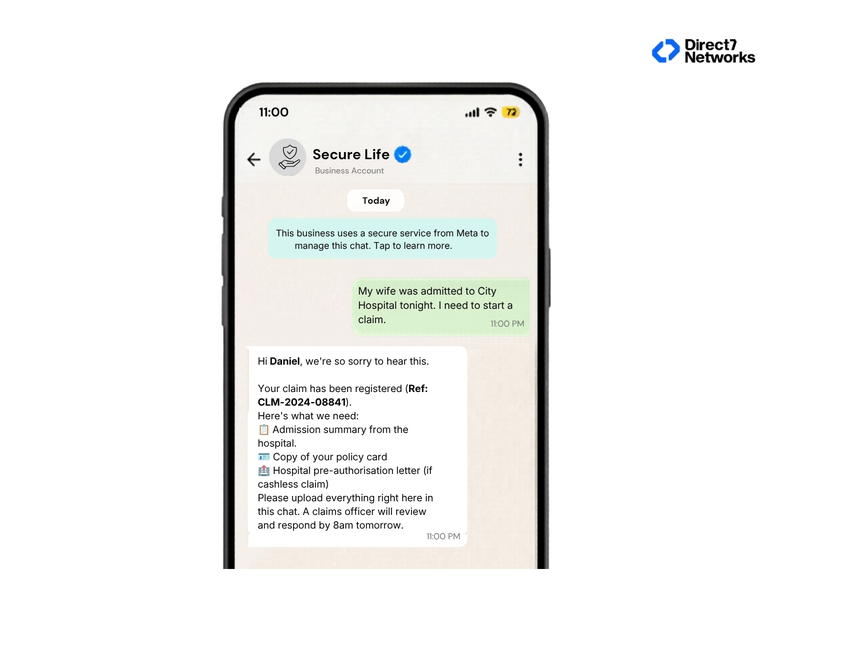
Daniel uploads the documents in the same thread. At 8 am, he receives a status update without calling anyone. By noon, he's told the pre-authorisation has been approved. He doesn't feel abandoned; he feels supported.
This is what WhatsApp for insurance claims support actually delivers. The channel supports photos, PDFs, voice messages, and location sharing — everything needed for First Notice of Loss (FNOL), document collection, and status updates. When a case becomes complex, the conversation escalates to a human agent within the same thread, preserving full context. The customer never has to repeat themselves.
Cross-Selling Without the Awkward Sales Call
Six months after a motor policy goes active, most agents do nothing. That's a missed opportunity. A customer with a clean claims record who responded promptly to renewal messages is the ideal candidate for a home insurance add-on, and the relationship is already warm.
A CRM-connected WhatsApp setup can flag this automatically, prompting the agent to send:
"Hi Mila! Six months since your motor policy, hope it's been smooth. A lot of our motor clients have been adding home contents cover lately, especially heading into monsoon season. I can put together a quick comparison, would that be useful?"
No cold call. No hard sell. Just a logical next step inside a conversation that already exists.
Other natural cross-sell triggers worth building into your workflow:
- Health policyholder at 24-month anniversary → second-year waiting period just cleared → good time to discuss a critical illness rider
- Term life customer who mentions a new child → family floater conversation
Motor + home policyholder with a business → introduce key-person or business interruption insurance
Automation Should Support Agents, Not Replace Them
One common mistake insurance teams make is over-automating conversations.
Insurance is trust-driven. Customers often need reassurance before making decisions involving money, family, or health.
Automation works best for:
- Lead acknowledgment
- Appointment confirmations
- Policy renewal reminders
- Payment alerts
- Document requests
- Basic FAQs
Human agents should handle:
- Coverage discussions
- Objection handling
- Claims disputes
- Financial concerns
- Complex recommendations
Customers can usually tell within seconds whether they are speaking to a real person or an overly scripted system.
The goal is operational efficiency without losing warmth.
Compliance and Privacy Cannot Be Ignored
Insurance involves sensitive personal information. That makes compliance especially important.
Agents should avoid:
- Sharing confidential customer details casually
- Sending policy documents to wrong numbers
- Using personal WhatsApp accounts for business at scale
- Storing customer information without proper systems
Using official WhatsApp Business API infrastructure gives agencies better control, audit visibility, and multi-agent management.
It also helps maintain consistency across teams.
Simple operational practices help significantly:
- Verify customer identity before discussing claims
- Use approved message templates
- Restrict internal access to customer data
- Maintain consent records for communication
Trust can disappear quickly after a single privacy mistake.
Common Mistakes Insurance Teams Make on WhatsApp
Even experienced teams misuse the channel.
Sending Too Many Messages
Frequent promotional broadcasts quickly become annoying.
Talking Like a Script
Customers want guidance, not robotic replies.
Delayed Human Follow-Up
Automation without agent intervention often kills qualified leads.
Overloading Customers With Documents
Too much information too early creates confusion.
Ignoring Existing Customers
Many agencies focus only on acquisition and neglect renewals and relationship-building.
Long-term retention usually produces higher profitability than constantly chasing new leads.
The Real Opportunity Is Relationship Continuity
The strongest insurance agents are rarely the most aggressive sellers. They are the people customers remember during important life moments.
WhatsApp supports continuity in a way traditional channels struggle to achieve.A customer may first contact an agent for motor insurance, return later for health coverage, and eventually ask about family protection plans, all inside the same conversation history.
That continuity builds familiarity, and familiarity builds trust.Insurance products may be complex, but communication should never feel difficult. The agents who simplify conversations, respond consistently, and stay genuinely helpful are usually the ones customers stay with for years.