
How SMS Delivery Works: Routing & Latency Explained
You send a one-time password (OTP) to a customer. It should arrive instantly but sometimes it takes 20 seconds… or never shows up at all. Meanwhile, your system logs say “sent successfully.”
That gap between sent and received is where SMS delivery actually gets interesting and complicated.
Behind every SMS is a chain of systems, operators, and routing decisions that directly affect delivery speed, reliability, and cost. If you rely on SMS for authentication, alerts, or campaigns, understanding this flow isn’t optional it’s operational knowledge.
What Actually Happens When You Send an SMS
Let’s break down the SMS delivery process step by step, without the jargon.
1. Your System Sends an API Request
Your application (CRM, backend, or marketing platform) triggers an SMS via an API.
Example:
A user logs in → OTP is generated → API call is sent to your SMS provider.
2. SMS Gateway Receives the Request
The SMS gateway acts as the bridge between your system and telecom networks.
It processes:
● Message content
● Destination number
● Routing logic
● Sender ID
At this stage, the provider decides how the message will travel.
3. Routing Through Aggregators or Direct Connections
This is where things start to diverge.
The message is routed either:
● Directly to a telecom operator
● Or through one or more intermediaries (aggregators)
We’ll break this down in detail in the next section.
4. Telecom Operator Processes the Message
The recipient’s mobile carrier receives the SMS and:
● Validates sender rules
● Applies filtering (spam, compliance)
● Queues the message for delivery
5. Message Reaches the Recipient Device
If everything goes well:
● The phone receives the SMS
● A delivery report (DLR) is triggered
That’s the ideal path. In reality, delays or failures can occur at multiple points.
SMS Routing Explained (Where Speed Is Won or Lost)
Routing is the most critical and least understood part of SMS delivery.
Direct Routes vs Grey Routes
Direct Routes
● Direct connection to telecom operators
● Faster and more reliable
● Higher cost
● Preferred for OTPs and critical alerts
Grey Routes
● Indirect, unofficial paths
● Lower cost
● Unpredictable delivery and higher filtering risk
If your OTP sometimes takes 30 seconds, there’s a good chance it’s using a lower-quality
route.
Role of Aggregators and Telecom Operators
Most businesses don’t connect directly to telecom operators worldwide.
Instead:
● SMS providers connect to aggregators
● Aggregators connect to multiple operators
High-quality providers (like Direct7 Networks) maintain direct operator relationships, reducing hops and improving delivery speed.
Domestic vs International Routing
Domestic SMS
● Usually faster
● Fewer intermediaries
● More predictable
International SMS
● More routing layers
● Cross-border filtering rules
● Higher latency risk
Why Routing Quality Matters
Routing determines:
● Delivery speed
● Success rate
● Message integrity
A shorter, cleaner route = faster delivery.
A complex, multi-hop route = delays and failures.
SMS Latency Explained (Why Messages Get Delayed)
SMS latency is the time it takes for a message to travel from sender to recipient.
It’s not always milliseconds. It can range from:
● 1–3 seconds (ideal)
● 5–15 seconds (acceptable)
● 30+ seconds (problematic)
Key Factors That Affect SMS Latency
1. Network Congestion
During peak times:
● Festivals
● Flash sales
● Large campaigns
Carriers queue messages, increasing delay.
2. Routing Path Complexity
More intermediaries = more processing time.
Think of it like flights:
● Direct flight → fast
● Multiple layovers → delays
3. Carrier Filtering
Operators scan messages for:
● Spam patterns
● Unauthorized sender IDs
● Regulatory compliance
Filtered messages may be delayed or blocked entirely.
4. Time of Day / Traffic Peaks
Bulk SMS campaigns often run:
● Morning (9–11 AM)
● Evening (6–9 PM)
This creates traffic spikes.
5. Message Type Priority
Transactional SMS (OTP, alerts):
● Often prioritized
● Lower priority
● Can be throttled
Why Some Messages Are Instant (and Others Aren’t)
Two messages sent at the same time can behave very differently.
Fast Delivery Scenario
● Direct route
● Low congestion
● Trusted sender ID
● Transactional priority
→ Delivered in seconds
Slow Delivery Scenario
● Multi-hop routing
● High traffic
● Filtering delays
● Promotional classification
→ Delayed or failed
How Delivery Reports (DLRs) Actually Work
Delivery reports are often misunderstood.
A DLR confirms:
● The message reached the carrier
● Or the recipient device (depending on network)
But:
● “Delivered” doesn’t always mean “read.”
● Some carriers provide limited visibility
Also, delays in DLRs don’t always match the actual delivery time.
Transactional vs Promotional SMS: Speed Differences
| Type | Use Case | Priority | Speed |
|---|---|---|---|
| Transactional | OTP alerts | High | Fast |
| Promotional | Marketing | Low | Slower |
Telecom networks are designed to protect user experience, so marketing messages often wait.
Practical Framework: Fast vs Slow SMS Delivery
Fast SMS Delivery Factors
● Direct operator routing
● Clean sender reputation
● Transactional classification
● Low network congestion
Slow SMS Delivery Factors
● Grey routes
● Multiple intermediaries
● Peak traffic
● Carrier filtering
Example 1: OTP Delivery Flow
- User requests login
- System triggers SMS API
- Gateway selects priority direct route
- Operator processes instantly
- OTP delivered within seconds
If routing changes latency increases user frustration rises.
Example 2: Bulk Campaign vs Priority Routing
Bulk Campaign
● Thousands of messages
● Lower-cost routes
● Queued by carriers
Priority Routing
● Fewer messages
● Direct routes
● Faster throughput
This is why marketing blasts don’t behave like OTPs.
Template: Choosing a Reliable SMS Provider
When evaluating providers, focus on:
● Do they offer direct operator connections?
● Can they control routing paths?
● Do they provide real-time delivery reports?
● How do they handle peak traffic?
● What’s their latency performance by region?
Providers with strong infrastructure (such as Direct7 Networks) typically optimize routing to minimize delays and improve reliability.
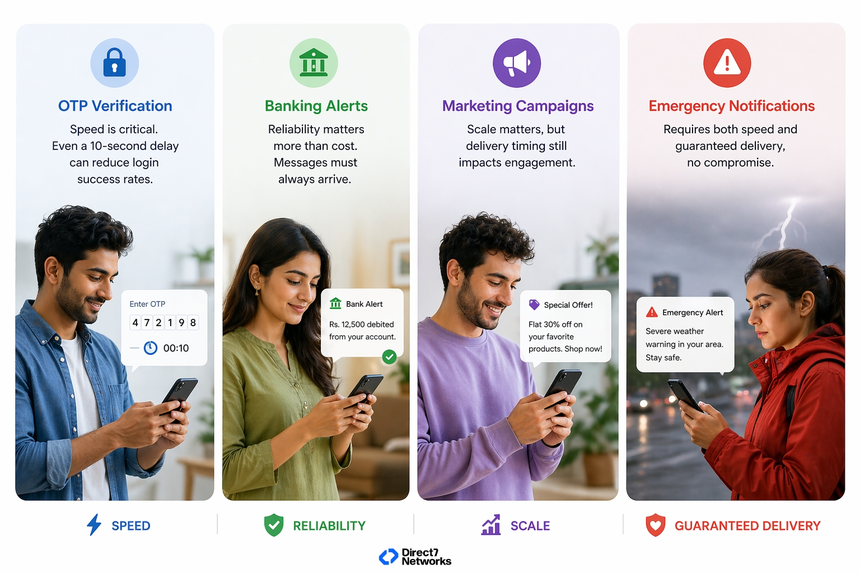
Real-World Use Cases
What Businesses Should Focus On
If SMS is part of your customer experience, the key isn’t just sending messages, it’s controlling how they are delivered.
Prioritize:
● High-quality routing
● Low latency infrastructure
● Reliable delivery tracking
Because in SMS, milliseconds often translate directly into user trust.