
OTP Verification Architecture: Building Secure and Reliable User Authentication
Learn how OTP verification architecture works, including secure generation, delivery, validation, scalability, and best practices.
Every digital interaction starts with a simple moment of trust. A customer logs into a banking app, approves an online payment, resets a forgotten password, or signs up for a new service. Underneath it, though, there's a whole system deciding whether to trust that person: where the code comes from, how long it lives, what happens if it's typed wrong, and what stops a bot from requesting a thousand codes a minute before a real user ever sees one.
For many businesses, One-Time Passwords (OTPs) remain the backbone of this verification process. Yet sending an OTP is only one small part of the equation. The real challenge lies in designing an OTP verification architecture that is secure, scalable, fast, and resilient enough to handle millions of authentication requests without frustrating legitimate users.
A well-designed architecture doesn't just prevent fraud. It protects customer trust, reduces operational costs, and creates a smoother user experience across every digital touchpoint.
What Is OTP Verification Architecture?
OTP verification architecture is the complete system responsible for generating, delivering, validating, and securing one-time passwords used for authentication.
Rather than focusing on the OTP itself, the architecture defines how every component works together, from the moment a user requests a code until the verification is completed or rejected.
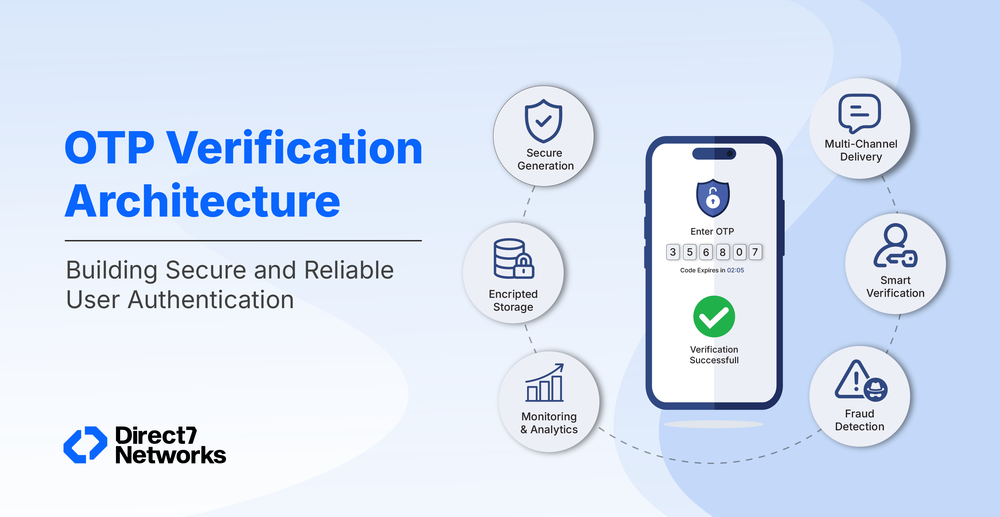
A typical architecture includes:
- User application (web or mobile)
- Authentication server
- OTP generation service
- Secure storage
- SMS, WhatsApp, email, or voice delivery provider
- Validation engine
- Fraud detection layer
- Monitoring and analytics
Each component plays a specific role in balancing security, speed, and reliability.
The Core Components of an OTP Verification System
1. Authentication Request
Everything begins when a user initiates an action that requires verification.
Examples include:
- Login
- Password reset
- New account registration
- High-value transaction
- Device verification
The application sends a request to the authentication server, which determines whether OTP verification is required based on predefined security rules.
For example, a banking application may require OTP verification only for transactions above a certain value, while an e-commerce platform may request one only during account creation.
2. OTP Generation
Once verification is required, the authentication service generates a random one-time password.
A secure OTP should be:
- Random and unpredictable
- Time-limited
- Single-use
- Cryptographically secure
Most organizations generate 4- to 8-digit numeric codes, although alphanumeric codes may be used in high-security environments.
The generated OTP should never be stored in plain text. Instead, modern systems store a hashed version similar to password storage.
5. User Verification
The user enters the received code.
The verification service checks:
- Does the OTP exist?
- Has it expired?
- Has it already been used?
- Does it match the stored hash?
- Has the retry limit been exceeded?
Only when every validation passes is authentication completed successfully.
4. OTP Delivery
The next step is delivering the OTP through the selected communication channel.
Common delivery methods include:
- SMS
- Voice calls
- Authentication apps
SMS remains the default for OTP delivery because it needs no app installation and works on virtually any phone, which matters enormously for businesses with a global or first-time-user audience. Its known weaknesses, SIM swap risk, delivery delays on congested networks, and no encryption in transit are real but manageable with the controls above rather than reasons to avoid SMS altogether.
Where it gets interesting is fallback design. If a code doesn't arrive within a few seconds, offering a WhatsApp OTP or a voice call as a secondary channel keeps completion rates high without asking users to do anything more complex. Companies working across markets with heavy WhatsApp usage, providers like D7 Networks build exactly this kind of multi-channel routing, so a failed SMS silently falls back to WhatsApp or voice rather than leaving the user stuck. The architecture point here isn't which provider to use; it's that fallback needs to be planned into the flow, not bolted on after users complain.
5. User Verification
The user enters the received code.
The verification service checks:
- Does the OTP exist?
- Has it expired?
- Has it already been used?
- Does it match the stored hash?
- Has the retry limit been exceeded?
Only when every validation passes is authentication completed successfully.
Security Layers That Strengthen OTP Verification
Generating an OTP is relatively easy. Protecting the entire verification process requires multiple security controls working together.
Expiration Windows
Most OTPs remain valid for only 30 seconds to 5 minutes.
Short expiration times reduce the opportunity for attackers to misuse intercepted codes while remaining practical for genuine users.
Retry Limits
Unlimited verification attempts create opportunities for brute-force attacks.
A common approach is allowing:
- Three to five incorrect attempts
- Temporary account lock
- New OTP generation after timeout
This significantly reduces unauthorized access attempts.
Rate Limiting
Attackers often automate OTP requests to overwhelm systems or abuse messaging services.
Rate limiting helps prevent this by restricting:
- OTP requests per minute
- Requests per device
- Requests per IP address
- Requests per phone number
This protects both infrastructure and messaging costs.
Device and Location Checks
Modern authentication systems evaluate additional signals before approving verification.
Examples include:
- Device fingerprint
- Browser characteristics
- IP reputation
- Geographic location
- Login history
If a login suddenly appears from another country or an unfamiliar device, additional verification may be required.
Common OTP Architecture Patterns
Different businesses require different architectural approaches.
Pattern 1: Centralized Authentication Service
A single authentication platform handles verification for every application.
Best suited for:
- Enterprises
- Multiple internal systems
- Shared customer accounts
Benefits include consistent security policies and simplified maintenance.
Pattern 2: Microservices-Based Authentication
Large organizations often separate authentication into dedicated services.
For example:
- OTP service
- User service
- Messaging service
- Fraud detection service
- Audit logging service
Each service scales independently, making this architecture ideal for high-volume applications.
Pattern 3: Event-Driven Architecture
Instead of direct communication, services exchange events using message queues.
Example:
- User requests login
- Authentication service publishes an OTP event
- Messaging service receives the event
- SMS is delivered
- Delivery confirmation updates monitoring dashboards
This approach improves reliability during traffic spikes because components operate independently.
Real-World Example: E-commerce Login
Imagine an online retailer during a major holiday sale.
Thousands of customers attempt to log in simultaneously.
A well-designed OTP verification architecture would:
- Generate OTPs instantly.
- Store them securely with automatic expiration.
- Route SMS traffic through multiple delivery paths.
- Monitor delivery success in real time.
- Detect unusual request volumes.
- Prevent repeated OTP abuse.
- Validate responses within milliseconds.
Customers experience a smooth login process, while the platform remains protected against fraud and system overload.
Common Mistakes Businesses Make
Many authentication problems originate from architectural decisions rather than OTP technology itself.
Some frequent mistakes include:
Storing OTPs in Plain Text
Even temporary credentials should never be stored without hashing.
Long Expiration Times
An OTP that remains valid for 15 or 20 minutes increases the risk of misuse.
No Retry Restrictions
Unlimited verification attempts expose systems to brute-force attacks.
Missing Audit Logs
Every authentication attempt should be logged for troubleshooting, compliance, and fraud investigations.
Ignoring Delivery Monitoring
Failed message delivery often goes unnoticed until users begin contacting support.
Tracking delivery rates, latency, and failure patterns helps identify issues before they affect large numbers of customers.
Designing for Scalability
As organizations grow, authentication traffic increases rapidly.
A scalable OTP verification architecture typically includes:
- Load-balanced authentication servers
- Distributed caching
- Stateless application services
- Multiple SMS delivery routes
- Database replication
- Centralized monitoring
- Automated failover
This ensures consistent authentication performance even during peak demand.
OTP verification isn't about picking a good six-digit generator, that part is solved and has been for years. The real work is in the architecture around it: catching risk early, sizing expiry and retries to the actual use case, and building fallback paths so a failed message doesn't cost you a customer. Get those three things right, and the whole system stays invisible to the people it's supposed to protect, which is exactly how good security should feel.